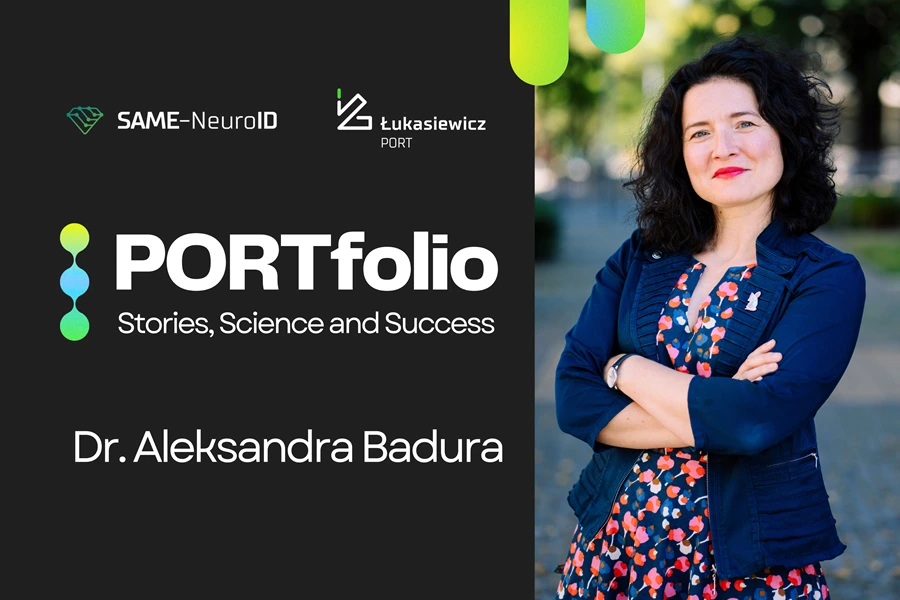
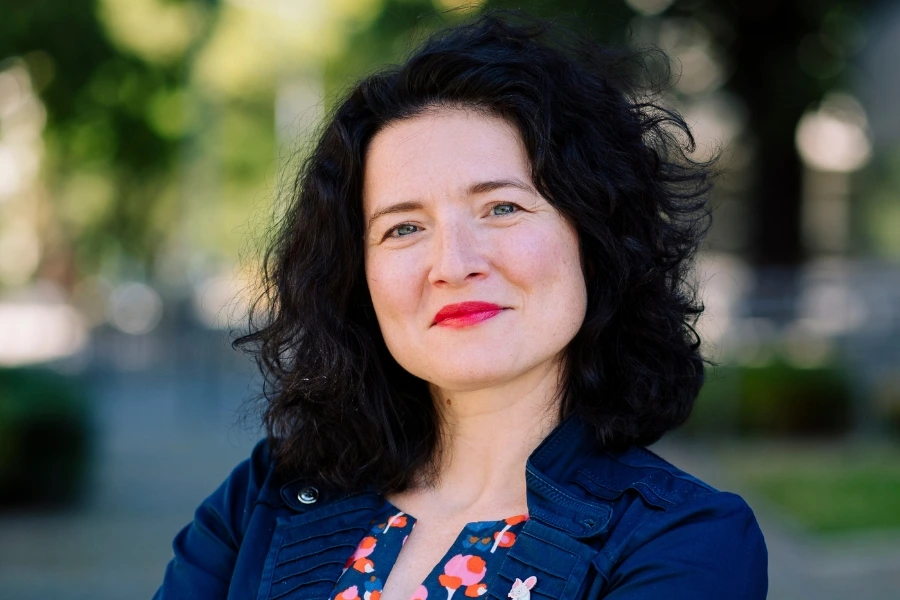
The guest of the latest episode of the PORTfolio podcast is Dr. Aleksandra Badura, Head of the Neural Networks Underlying Behavioral Flexibility Laboratory at Erasmus Medical Center in Rotterdam. Her team investigates how the cerebellum influences behavioral flexibility and how its dysfunctions may contribute to the development of autism.
The interview with Dr. Badura was conducted by Dr. Raluca Contu from the Biology of Astrocytes Research Group at Łukasiewicz – PORT, and the meeting took place during the 17th International Congress of the Polish Neuroscience Society, co-organized by Łukasiewicz – PORT.
From Sleep to the Cerebellum – a Scientific Journey from Poland to Rotterdam
Dr. Badura fondly recalls the beginnings of her scientific career. Twenty years ago, she left Poland to pursue her dream of studying the brain. Although she studied psychology at Jagiellonian University, already during her master’s thesis she became interested in neurophysiology and sleep research. Later, thanks to an international fellowship, she joined a laboratory specializing in epilepsy, where she saw live brain activity for the first time.
– The moment I saw a change in the EEG recording during an epileptic seizure was a breakthrough for me. I thought: this is it. I can observe how the brain works—in health and in disease – the researcher recalls.
Over time, her interests shifted toward the cerebellum—a structure previously regarded mainly as a center for motor control. As she admits, she encountered it by chance, but her fascination with the complex organization and functions of this part of the brain shaped her further career.
The Cerebellum, Cognition, and Autism
Research conducted by Dr. Badura’s team shows that the cerebellum plays an important role not only in movement but also in cognitive and social processes. Disturbances in its functioning—especially during early development—may affect how the brain forms connections with the neocortex, which is crucial for understanding, among others, the mechanisms of autism.
– Damage to or dysfunction of the cerebellum during development not only affects the cerebellum itself but changes the entire pattern of communication between it and the cerebral cortex. This can lead to cognitive and social impairments – explains Dr. Badura.
The scientist emphasizes that in her work she increasingly uses the term autism rather than autism spectrum disorders, as the word “disorder” implies deficit rather than diversity.
Her laboratory focuses on early identification of autism—especially in girls and women, who until recently were often overlooked in diagnostics. At the same time, she highlights co-occurring conditions such as epilepsy or intellectual disability, which may require therapeutic intervention.
Women in Science
In the conversation, Dr. Badura openly discusses the experiences of women in the scientific environment—both the challenges and the gradual changes taking place.
– When I see my colleagues becoming professors or heads of institutes, I know they are paving the way for the next generations. That gives hope – she says.
Although inappropriate comments or stereotypes still occur, as she notes, awareness and solidarity among women in science are growing. Increasingly, they form support networks that help them get through difficult moments and stay motivated.
Advice for Young Scientists
Dr. Badura also shares advice she often gives her students:
– In Poland we have a saying: if they throw you out the door, come in through the window. That’s exactly what a scientific career looks like. Don’t give up after the first failure. Seek support, collaborate, build networks. Science is not a solitary race—it’s a shared journey.