The project is carried out under the TEAM-NET program of the Foundation for Polish Science as part of the Smart Growth Operational Programme 2014–2020.
Priority IV: Increasing the research and development potential
Measure 4.4: Increasing human resources potential in R&D
Total funding: 13,208,000.00 PLN
Łukasiewicz – PORT funding: 3,499,250.00 PLN
Project implementation period: 01/10/2019 – 30/09/2023
Principal Investigator: Dr. hab. Alicja Bachmatiuk

Project consortium:
• Łukasiewicz – PORT Polish Center for Technology Development – Consortium Leader
• Wrocław University of Science and Technology
• Silesian University of Technology
• Warsaw University of Technology
The aim of the project is to establish a scientific network composed of research centers specializing in integrated photonics. The newly established group of specialists will build upon the expertise, collaboration, and engagement of the participating research groups.
The project proposes the creation of a mechanism integrating competencies and developing a universal material platform based on newly investigated hybrid materials. These materials will be based on silica compounds with additives such as TiO₂ or SnO₂ used as structural matrices, doped polymer coatings (active or protective layers), organic dyes, and active two-dimensional materials such as transition metal dichalcogenides, graphene hybrids, and boron nitride.
All these materials have demonstrated unique structural, optical, and electrical properties in previous studies. The project includes the fabrication and characterization of materials, technology development, and the design and manufacturing of passive and active components.
Service developed under the project:
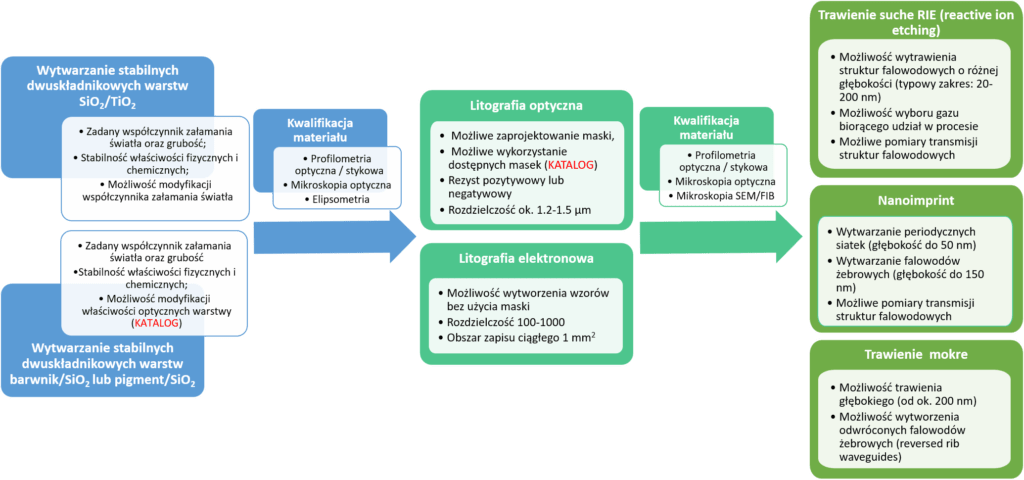
Regulations of the service under HYPHa | DOWNLOAD
Teams
Łukasiewicz – PORT
The research conducted in the Advanced Materials Synthesis Research Group focuses on designing and synthesizing inorganic compounds (phosphors, metallic or oxide nanoparticles) and organic compounds with tailored physicochemical properties, including luminescent, thermochromic, thermal, mechanical, antibacterial, electrical, and sensing characteristics.
Wrocław University of Science and Technology
The research team from the Department of Optics and Photonics is part of the Optical Fiber Group. The group has the knowledge and equipment necessary to study conventional and specialty optical fibers (including photonic fibers) and a wide range of fiber-optic elements and devices.
Capabilities include measurements of phase and group modal birefringence across a broad spectral range, polarization-mode dispersion, chromatic dispersion, transmission loss, bending loss, and polarization-dependent loss.
Warsaw University of Technology
The main research focus of the team from the Division of Optoelectronics is the design and characterization of integrated optics components and systems for a wide range of applications, including sensing structures and systems, as well as optical telecommunication systems using WDM techniques.
The group specializes in designing both individual components (e.g., single sensor elements) and fully integrated photonic systems, along with experimental validation of the designed structures.
Silesian University of Technology
The Photonics and Nanotechnology Team is a multigenerational, interdisciplinary group of scientists, including physicists, chemists, a mechatronics engineer, and a biotechnologist. Their work under the HYPHa project focuses on the design, fabrication, and characterization of integrated optical structures, particularly for planar fiber-optic sensor applications.
The foundation of this research are composite SiOx:TiOy waveguide layers developed by the team using the sol-gel method and dip-coating technique. These layers exhibit a high refractive index (1.8) and exceptionally low optical losses.

