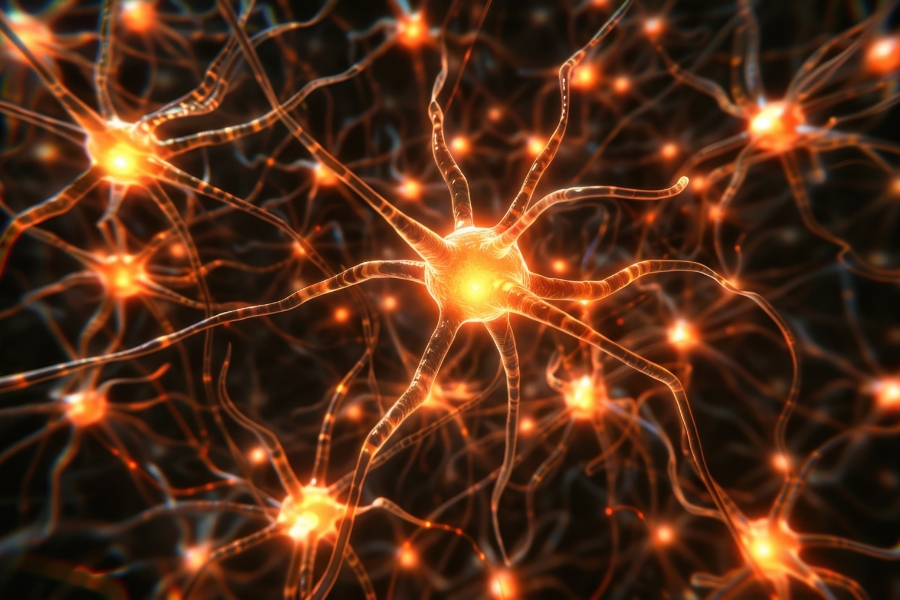
Scientists at the Life Sciences and Biotechnology Center at Łukasiewicz – PORT work every day on therapies that may contribute to breakthroughs in the treatment of severe disorders. On Rare Disease Day, observed annually on the last day of February, we present the latest approach to treating Huntington’s disease, which is the subject of research conducted by Dr. Agnieszka Krzyżosiak and the Neurodegeneration Mechanisms Research Group she leads at our Institute.
Huntington’s disease is a rare genetic neurodegenerative disorder that affects an estimated 5 in 100,000 people. As the disease progresses, its most severe symptoms include uncoordinated, involuntary movements, motor problems, emotional symptoms such as depression, and cognitive impairment.
It is the most common neurodegenerative disease caused by a single genetic factor. The direct cause is the expansion of a polyglutamine chain in the huntingtin protein, leading to protein aggregation and, consequently, a series of cellular dysfunctions, deregulation of cellular proteostasis, and ultimately – cell death, meaning the death of neurons in the brain.
One of the major risk factors is age (35–50 years).
“In our work, we investigate the molecular basis of Huntington’s disease, focusing primarily on protein quality control processes to better understand the accumulation of huntingtin in the cell,” explains Dr. Agnieszka Krzyżosiak, Leader of the Neurodegeneration Mechanisms Research Group at Łukasiewicz – PORT. “Our earlier studies confirmed that a cell in which proteostasis has been pharmacologically enhanced is better able to cope with the aggregation of disease-causing protein. Knowing that this approach – targeting protein quality control processes – is effective, we are currently searching for new therapeutic targets,” adds Dr. Agnieszka Krzyżosiak.
Innovation in Research
What makes Huntington’s disease research at Łukasiewicz – PORT innovative is the use of human patient-derived models as an alternative to animal models. The research method, based on reprogramming unaffected cells (e.g., skin fibroblasts) into neurons, was developed by Prof. Andrew Yoo (USA). The innovative nature of this method is demonstrated by its ability to reprogram cells in such a way that they reflect both the genetic and epigenetic background of the disease.
With the latest tools and research methods, and scientists who have gained expertise in this disease at international research centers, we hope to move closer to establishing new standards in the treatment of Huntington’s disease.