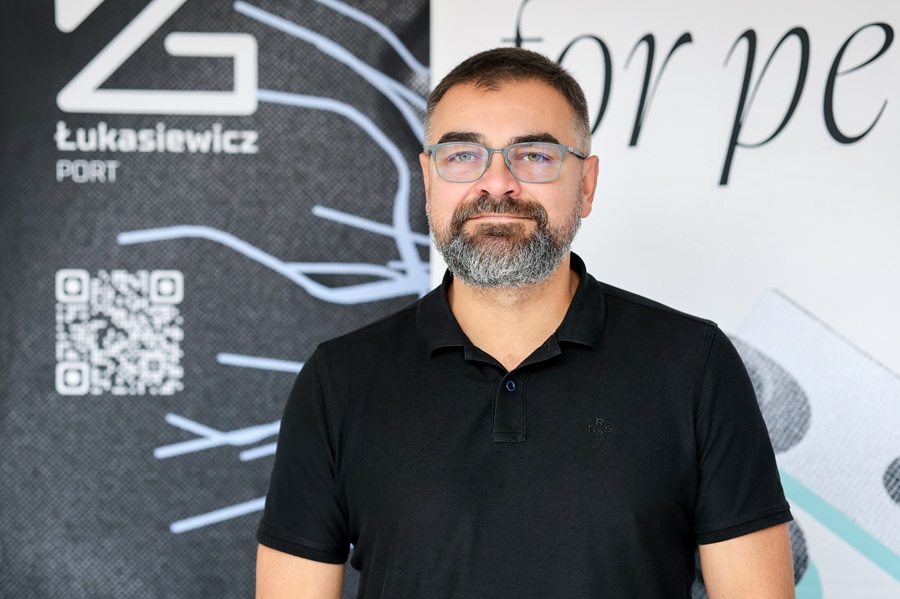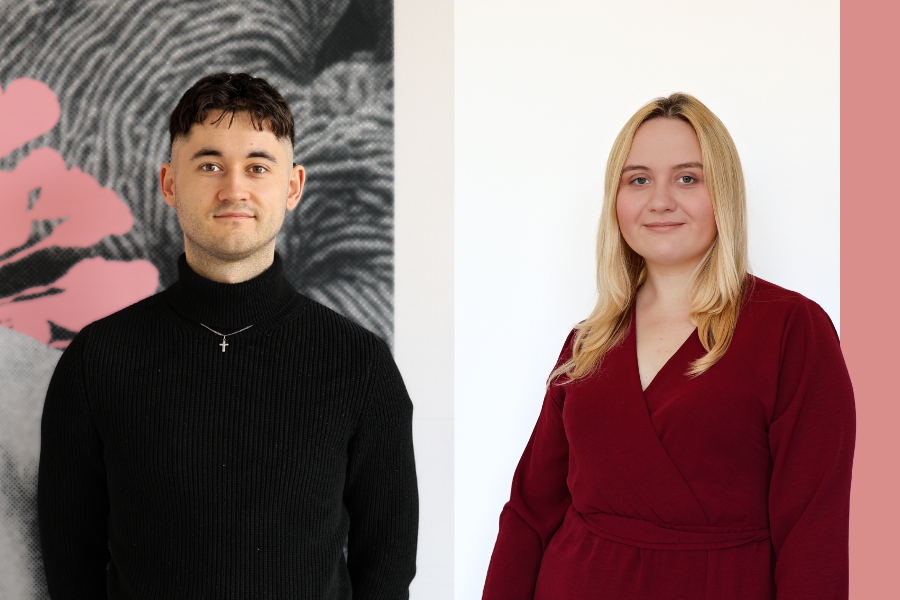
Kacper Prokop has been awarded the Max Born Scholarship in the field of physical and chemical sciences. Weronika Zając received a distinction in the same category. Both work in the Advanced Materials Synthesis Research Group and are pursuing industrial doctorates.
The scholarship granted by the Mayor of Wrocław is awarded annually to doctoral students with outstanding scientific achievements who conduct research in fields important for the city’s development. This year’s list of top awardees includes Kacper Prokop and Weronika Zając, both carrying out industrial doctorates in collaboration between the University of Wrocław and Łukasiewicz – PORT. They are also members of the Advanced Materials Synthesis Research Group, led by Dr. hab. Joanna Cybińska.
Transparent ceramics and international collaboration
Kacper Prokop conducts research on transparent ceramic sinters based on phosphates and tungstates activated with rare-earth ions, which may be used in modern optical technologies—such as laser sources, scintillators, or LED phosphors. Transparent ceramics are a promising alternative to single crystals, offering higher mechanical strength, lower production costs, and the possibility of shaping them into virtually any form.
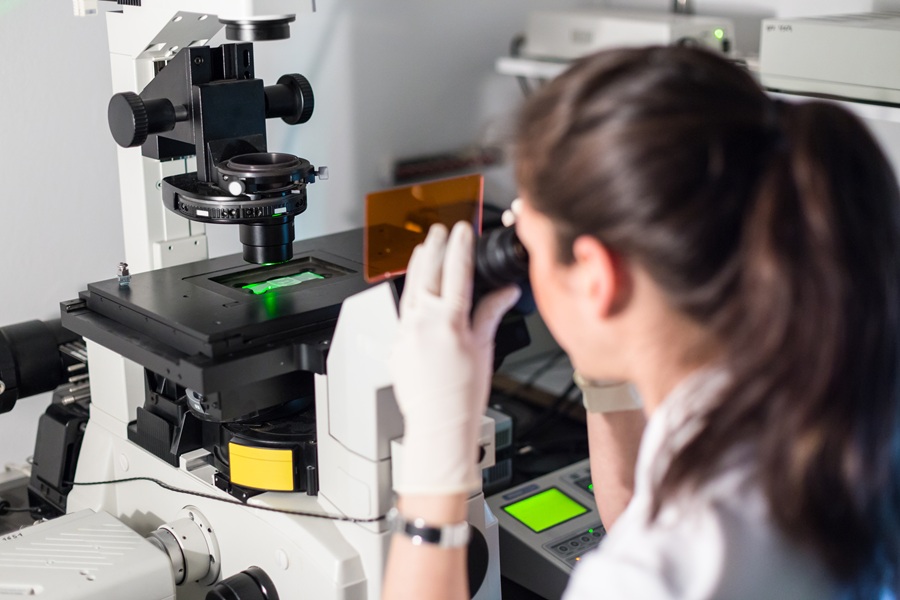
His work includes the synthesis of new ceramic powders, sintering processes (including SPS – Spark Plasma Sintering and HIP – Hot Isostatic Pressure), and full spectroscopic characterization of the materials. His research is carried out in close international collaboration with Claude Bernard University and the MatéIS INSA laboratory in Lyon, allowing knowledge exchange with French scientists and access to cutting-edge technologies.
At Łukasiewicz – PORT, the doctoral student gains experience in chemistry and photonics. His work includes the synthesis of organic dyes, development of oxide composites for catalysts, and production of graphene using CVD methods. He has also worked in the Clean Room Laboratory, participating in optical lithography processes and waveguide fabrication.
“In the institute, I not only develop my scientific competencies but also learn how to introduce innovative laboratory solutions into industry. This allows me to gain experience in implementing new technologies into real-world applications, including patent transfer, product development, and commercialization of advanced materials. It’s a unique combination of academic knowledge and practical, application-driven experience that gives me more opportunities and helps me connect theory with the actual needs of the market,” says Kacper Prokop.
Photonic sensors inspired by nature
Weronika Zając’s research focuses on designing and fabricating photonic crystals with sensing properties, which may be used, for example, in pollutant detection. Photonic crystals are materials with an ordered internal structure capable of controlling the propagation of light. Similar structures appear in nature—for instance, in bird feathers, beetle shells, or gemstones. Inspired by these natural patterns, researchers are developing materials that change their optical properties upon contact with selected substances (e.g., acid vapors, ions, or bioanalytes).
The main advantage of these materials is the simplicity of result interpretation—the outcome can be seen with the naked eye, without sophisticated equipment. The doctoral student designs both three-dimensional photonic crystals made from polymer and silica spheres, as well as hydrogel-based photonic systems, in which the spaces between the spheres are filled with material that reacts selectively to specific molecules.
“These materials offer an interesting alternative to expensive laboratory methods. They may also be applied in monitoring water and food quality, as well as in health and environmental protection,” summarizes Weronika Zając.