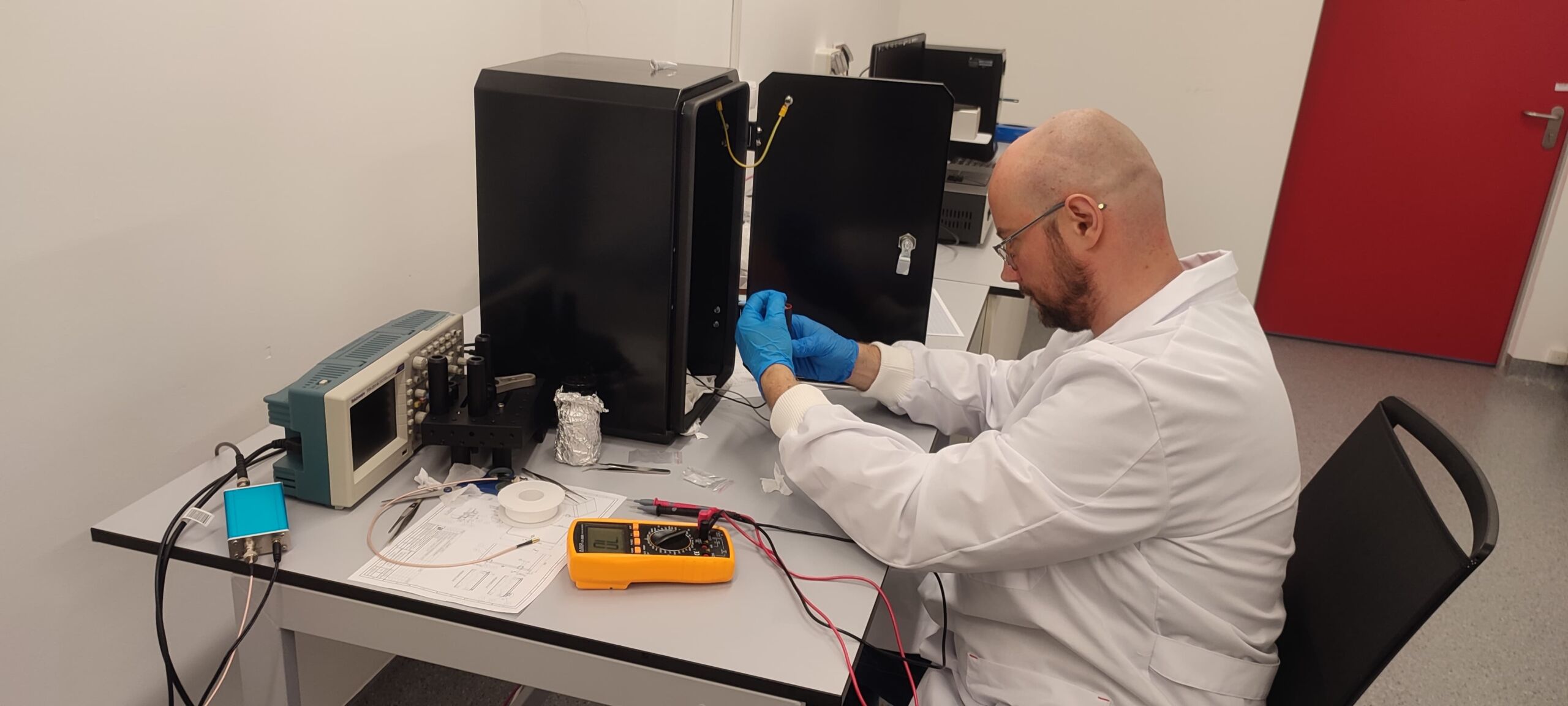
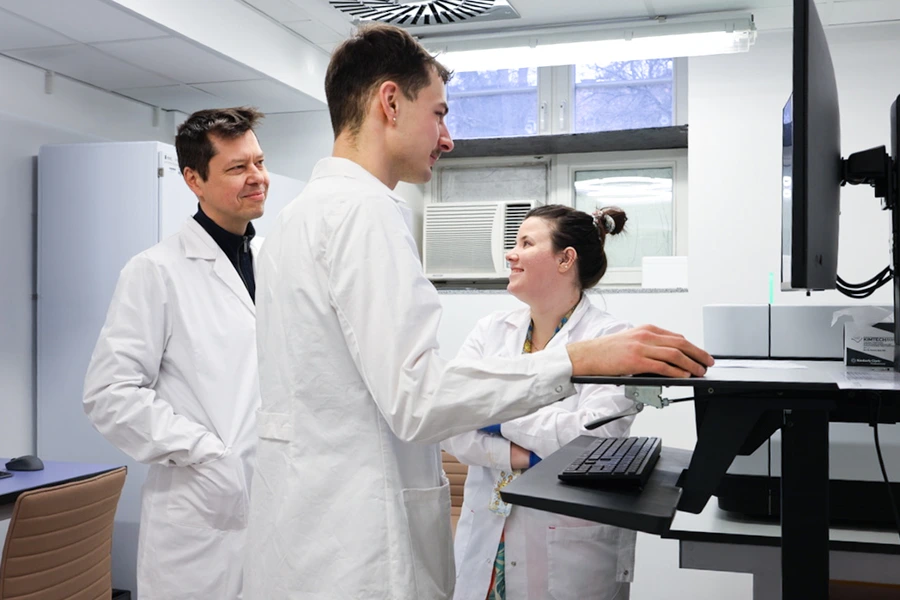
Dr. Michał Makowski from the Phototonic Materials Research Group, the first author of the article “Scaling Up Purcell-Enhanced Self-Assembled Nanoplasmonic Perovskite Scintillators into the Bulk Regime” published in Advanced Materials, explains the Purcell effect, methods to increase scintillation efficiency, and the prospects for reducing the costs of medical examinations such as PET tomography.
Scintillators: From Radiation Detection to PET Imaging
“A scintillator is a material capable of absorbing ionizing radiation — invisible and highly dangerous to humans — and converting it into light. In essence, it acts as an optical warning signal,” explains Dr Makowski.
“We do not need to be near a nuclear plant to encounter ionizing radiation. With today’s rapid technological progress, it appears in many settings — medical diagnostics, industry, and even space research.”
Scientists are searching for scintillation materials that are both ultra-fast and ultra-efficient. However, producing such materials remains extremely costly. One cubic centimetre of lanthanum bromide, commonly used in PET scanners, costs around €1,000.
“We decided to explore alternative approaches, specifically the use of photonic techniques to improve scintillator performance,” says Dr Makowski. “A key factor here is the Purcell effect, which increases the amount of light emitted by the material. When a molecule is excited, it releases energy — and by placing metal nanoparticles near the emitter, we can increase the probability that this energy will be released as light, and shorten the emission time. Crucially, the molecules and nanoparticles must not touch, as direct contact suppresses emission.”
Amplifying the Purcell Effect in Bulk Materials
Until now, research on the Purcell effect has focused primarily on thin-film materials, limiting sample thickness. The innovative approach described in Advanced Materials involves embedding perovskite nanocrystals and metallic nanoparticles together within a polymer matrix.
“This creates multiple local ‘hot spots’ of the Purcell effect. As a result, we are no longer constrained by sample thickness — our imagination becomes the only limit,” emphasises Dr Makowski.
“This is a breakthrough, because we demonstrated that the Purcell effect can operate effectively in bulk materials. By harnessing it, we can enhance gamma-ray-induced scintillation. In the future, this may lead to cheaper and more efficient PET imaging, improved radioactive contamination detection, and new applications in space research.”
The Photonic Materials Research Group, led by Dr M. Danang Birowosuto, specialises in the growth and characterization of perovskite materials and in leveraging photonic phenomena to improve their performance. Current work focuses on achieving similar effects in lead-free materials. The researchers hope their findings will pave the way for broader practical applications.