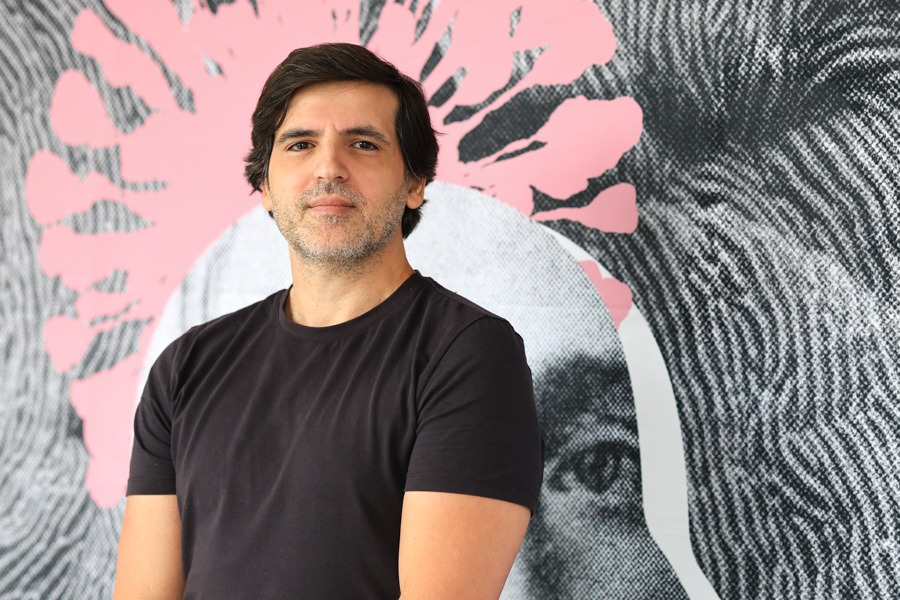
Dr Dominik Kowal from the Materials for Photonics Research Group at Łukasiewicz – PORT discusses the current state of research on nuclear batteries and their potential applications. He is the first author of the paper “Current trends in material research for nuclear batteries: Harnessing metal perovskite halides and other chalcogenides for greater compactness and efficiency”, published in March in Applied Physics Reviews, a journal issued by the American Institute of Physics.
– This publication reviews the currently used approaches to nuclear batteries, concepts of their architecture, and the application of specific materials. One of the main areas of our research is perovskite materials, while our partners from Indonesia, led by Dr Arramel, specialize in chalcogenides. Together we wrote an article focusing on the use of these innovative materials in radiovoltaic, radio-photovoltaic and thermoelectric nuclear battery technologies. We also presented original concepts that have not been described before, including enhancing nuclear battery performance through the use of nanophotonics – explains Dr Kowal.
How a nuclear battery works
Unlike widely used lithium-ion batteries, nuclear batteries do not rely on chemical reactions, but on physical processes. Energy provided by a radioactive source is converted directly into electricity. In such batteries, intermediate materials play a crucial role: they efficiently capture radiation emitted by the radioisotope and convert it into usable electrical energy. Compounds such as the chalcogenides and perovskites described in the article can serve this purpose.
– We focus primarily on radiovoltaic batteries, whose operating principle is similar to photovoltaics. In solar cells, sunlight is converted into electricity; here, we obtain energy from the radiation of a radioisotope. Such radioisotopes can come, for example, from nuclear power plant waste – adds the scientist.
The main advantages of nuclear batteries are their small size and extremely long operating time. They deliver relatively low but constant power and can function for decades.
– Energy is highly concentrated in radioactive sources, but due to the slow rate at which it is released, it is spread over time, resulting in limited power output – explains Dr Kowal.
A nuclear-powered pacemaker
With the appropriate choice of radioisotope, the emitted radiation can be easily shielded and poses no threat to humans. One of the most compelling examples demonstrating the safety of such batteries is the concept of using them in cardiac pacemakers.
Other potential applications include mining shafts and outer space, where regular replacement of power sources is extremely difficult, as well as the defence sector, where they could provide reliable power supplies for soldiers operating in the field. In this context, research on nuclear batteries aligns with one of the strategic development directions of the Łukasiewicz Research Network and Łukasiewicz – PORT: national defence and security.
Currently developed nuclear batteries are designed to operate for up to 50 years, but parallel efforts are underway to increase their efficiency, which would broaden their range of applications.
– For example, we would like to use nuclear batteries in so-called MEMS systems (microelectromechanical systems), which are tiny electromechanical devices that generate motion, such as micro-levers. These are electrically driven mechanisms, similar to electric motors, but on a microscale – says Dr Dominik Kowal.
The search for higher power density
Work on increasing the potential of nuclear batteries is ongoing.
– The simplest way to obtain higher power from a battery is to increase its size, because power scales with surface area – explains Dr Kowal. – A larger radioisotope surface will emit more radiation that can be converted into electricity. However, larger batteries are less practical. Ultimately, the challenge is power density: enabling a relatively small battery to deliver relatively high power while operating for as long as possible. That is the Holy Grail we are looking for.