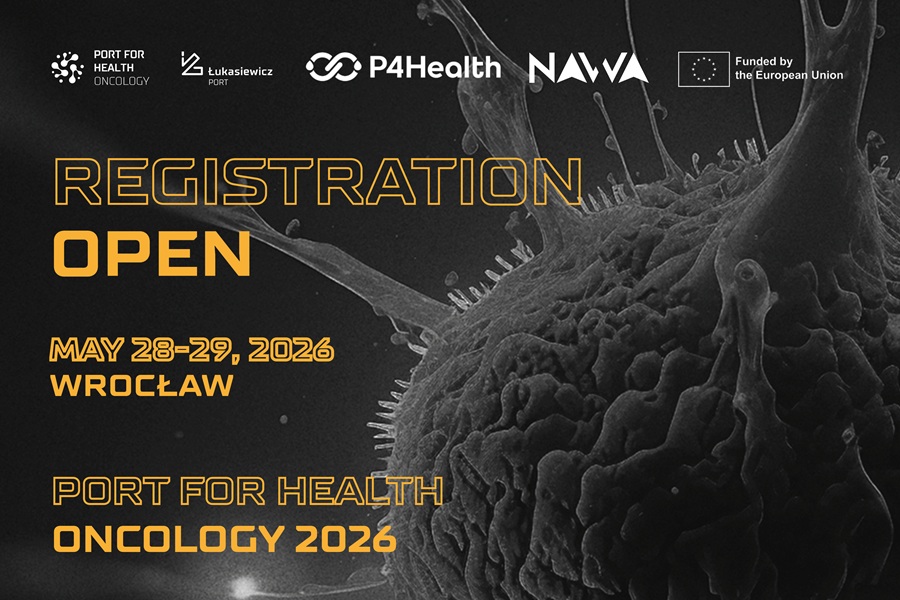
Leading scientists, clinicians, industry representatives, and innovators working at the intersection of oncology, neuroscience, and precision medicine will meet at Łukasiewicz – PORT on May 28–29, 2026. The international conference is dedicated to the latest advances in cancer research, diagnostics, and therapy.
Participants will have the opportunity to attend two days of lectures and scientific discussions. The program includes more than 20 presentations by internationally recognized experts, who will address key challenges and emerging directions in oncology research.
The conference will be available both onsite and online, enabling participants from around the world to take part and actively engage in the international scientific discussion.
Cancer research is currently undergoing rapid transformation. Advances in molecular biology, imaging technologies, and computational analysis are enabling researchers to gain increasingly precise insights into how tumors develop, how they interact with surrounding tissues, and how they respond to therapy.
PORT for Health: Oncology 2026 focuses on key areas shaping contemporary oncology research. The conference program is organized into several thematic sessions reflecting the most important research directions in the field.
Conference Program
The opening session will focus on the fundamental mechanisms of tumor development and interactions with the immune system. Speakers include:
- Aurélie Poli, presenting research on AllergoOncology and the relationship between allergies and glioblastoma
- Joanna Poźniak, discussing the role of cytotoxic NK cells in melanoma immunotherapy response
- Camille Chatelain, addressing the induction of tertiary lymphoid structures through dendritic cell reprogramming
- Tim Halim, exploring the role of ILC2 cells in tissue homeostasis and neoplasia
The second session will explore the growing field of cancer neuroscience, which investigates interactions between tumors and the nervous system. Speakers include:
- Andrew Shepherd, discussing latent neuropathy in colorectal cancer survivors
- Christina Møller Andreasen, presenting research on bone microenvironment remodeling during tumor infiltration
- Christoph Klose, analyzing the role of the enteric nervous system in regulating stem cell differentiation and immune responses
A session dedicated to new therapeutic strategies will focus on the latest advances in targeted therapies and immunotherapy. Speakers include:
- Tobias Bald, presenting research on AI-designed minibinders targeting previously unexplored cancer mechanisms
- Helena Florindo, presenting research on the use of nanomedicine for neuroimmune modulation
- Gabriel van der Pluijm, discussing the use of oncolytic viruses as enhancers of immunotherapy effectiveness in urological cancers
The second day of the conference will continue discussions on advanced therapeutic strategies, including:
- CAR-T therapy in lymphoma treatment – presentation by Jarosław Dybka on the latest advances and future directions in CAR-T therapy for lymphomas
- Spatial regulation of γδ T cells in receptor-guided immunotherapy – presentation by Jürgen Kuball, analyzing how spatial immune cell dynamics can support next-generation immunotherapies
- Expanding CAR therapy targets beyond protein antigens – online presentation by Sébastien Wälchli, focusing on innovative approaches broadening the scope of CAR-T therapies
- New perspectives in glioblastoma treatment – lecture by Stefaan van Gool, discussing therapeutic strategies beyond the current standard of care
Plenary Lecture by Brain Prize 2025 Laureate Frank Winkler
Professor Frank Winkler is an internationally recognized researcher studying interactions between cancer cells and the nervous system, particularly in the context of brain tumors. His research has demonstrated that cancer cells can form functional connections with neurons, significantly changing our understanding of tumor growth and progression in the brain.
These discoveries have opened new directions for the development of therapeutic strategies targeting not only cancer cells themselves but also the neuronal networks that support tumor growth.During his plenary lecture, Professor Winkler will present an overview of these discoveries and discuss their significance for the future of neuro-oncology and precision medicine.
From Laboratory Discoveries to Clinical and Industrial Applications
In addition to scientific sessions, the conference program also includes the PORT for Business segment, which highlights the growing role of industry in translating scientific discoveries into practical medical solutions. During this part of the conference, biotechnology companies and startups will present their technologies and innovations based on scientific research.
This format reflects the increasingly collaborative nature of biomedical innovation, where academic research, clinical practice, and industrial technology development intersect, accelerating the development of new cancer therapies.
The PORT for Health Initiative
PORT for Health is an international conference series organized by Łukasiewicz – PORT. The initiative aims to create a platform for scientists, clinicians, and innovators to discuss key challenges in contemporary biomedical research and healthcare.
The PORT for Health: Oncology 2026 edition continues this mission by addressing some of the most important and current issues in cancer research. The hybrid format ensures broad accessibility for participants from different parts of the world, while also enabling direct meetings and discussions for those attending the conference onsite.
More information and registration: https://health.port.org.pl/register