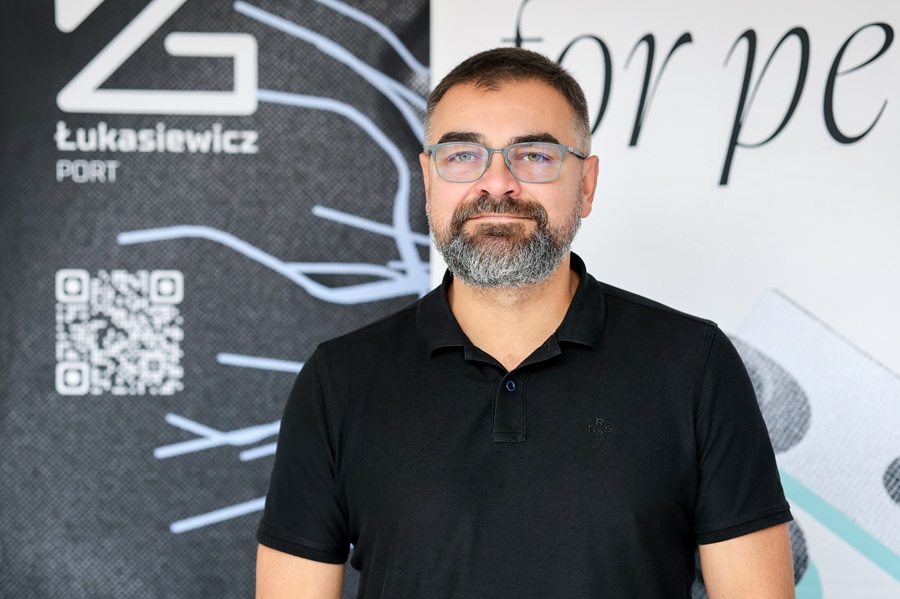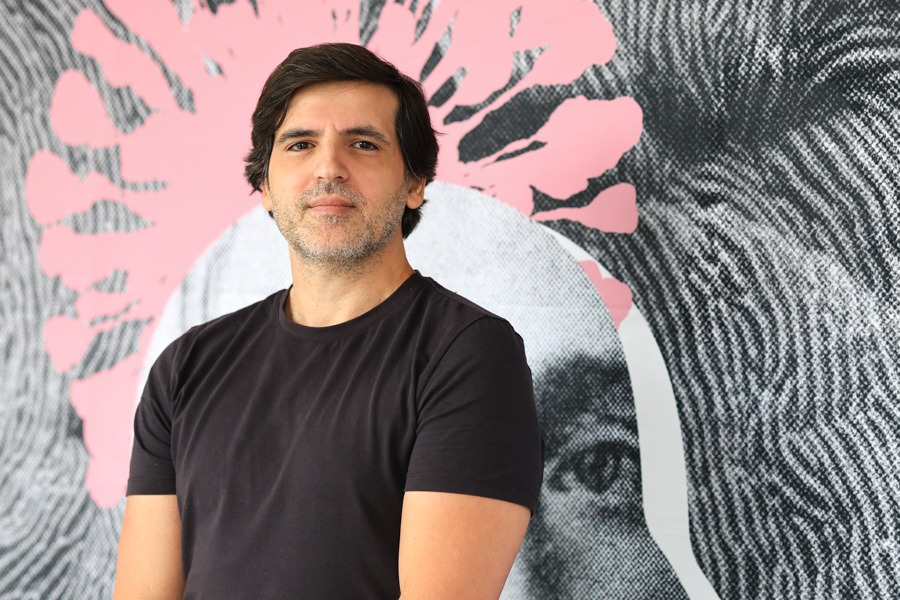
“I follow wherever the data lead me,” says Dr. Vitor Cabral, who has spent years building his scientific expertise across disciplines and continents – from classical microbiology and genetics, through infection biology, to synthetic biology and translational research. Today, at Łukasiewicz – PORT, he draws on this interdisciplinary background to design microbiome-based therapeutic strategies.
Research shows that the gut microbiome performs a range of essential biological functions: it regulates immune responses, influences metabolism, supports intestinal epithelial regeneration, and protects the host against pathogen colonization. Disruption of this ecosystem – for example, following antibiotic treatment – increases susceptibility to infections and inflammatory conditions. Dr. Cabral’s work focuses on translating this knowledge into practice: how can we identify protective bacterial strains and transform them into effective therapeutic tools?
An interdisciplinary scientific path
Each stage of Dr. Cabral’s scientific career brought new tools and perspectives. During his PhD, he focused on microbiology and genetics. His postdoctoral training in the United States introduced him to infection biology and experimental models that more closely reflect physiological conditions in living organisms. He later transitioned into synthetic biology, learning how to design and engineer biological systems.
After years of working across multiple fields, he realized that postponing scientific independence no longer made sense. “I thought to myself: either I try to establish my own lab and pursue my own research now, or I never will,” he recalls.
Today, Dr. Cabral speaks candidly with younger researchers about how the academic landscape has changed. When he began his career, longer postdoctoral appointments were considered an advantage. Now, funding systems increasingly reward earlier independence. Paradoxically, spending too many years “gaining experience” can limit access to competitive grants and career opportunities.
At Łukasiewicz – PORT, Dr. Vitor Cabral leads the Therapeutic Microbiomics Research Group and pursues a strongly translational approach, with clinical applications in mind from the very beginning. He aims to build on the full breadth of his previous experience to develop microbiome-based therapies and to treat bacteria as genuine therapeutic products rather than merely biological curiosities.
His team searches for bacterial strains that can function as next-generation probiotics. However, the goal goes far beyond dietary supplements. Instead, the focus is on solutions that undergo rigorous testing for safety and efficacy – held to standards comparable to those required for pharmaceutical drugs.
Klebsiella ARO112 – a bacterium that supports microbiome recovery
One of the important stages in Dr. Cabral’s professional career was his research on the Klebsiella ARO112 strain. It turned out that the bacterium helps rebuild the microbiome after antibiotic therapy and limits colonization by harmful microorganisms.
“We identified a bacterium that protects the microbiome from invasion after antibiotics,” Dr. Cabral explains. “It supports microbiome recovery, reduces inflammation, and helps the host regain physiological balance.”
The detailed findings were described in a study published in December in Nature Communications, where the researchers reported both the strain’s mechanism of action and the results of extensive preclinical testing.
Subsequent studies evaluated the therapeutic potential of Klebsiella ARO112 in the context of inflammatory bowel disease (IBD). The results proved even more promising: the bacterium not only supported microbiome regeneration but also helped clear infections.
Safety was equally critical. The strain underwent comprehensive preclinical evaluation and demonstrated a very low capacity to acquire antibiotic resistance – a particularly valuable feature at a time when antimicrobial resistance is recognized as one of the most serious global health threats. In practice, the strain functions as a next-generation probiotic: rather than simply replenishing missing bacteria, it actively stabilizes the entire intestinal ecosystem.
Dr. Cabral also notes that many commercially available probiotics are marketed as dietary supplements. The reason is straightforward: the regulatory pathway is much easier. Manufacturers are not required to demonstrate clinical efficacy – only safety. As a result, products with genuine benefits often sit on the same shelves as those with little or no measurable effect. His team has chosen a more demanding path: developing solutions that are treated as bona fide medical therapies, supported by rigorous studies and clear evidence of effectiveness.
The microbiome as an ecosystem
For Dr. Cabral, it is not enough to study a single beneficial bacterium in isolation – the broader context matters just as much: “I look at the microbiome from an ecological perspective, that is, as an ecosystem – an entire community of organisms rather than individual species.”
Whether a given therapy works depends on the whole microbial “neighborhood.” That is why the same probiotic may help one patient but have no effect in another. Not because it does not work, but because it encounters a completely different biological environment. Dr. Cabral aims to understand which interactions between bacteria determine these outcomes.
He also places great importance on collaboration with hospitals, which will enable research using patient-derived samples. Only studies conducted in real, diverse populations will provide a complete picture.