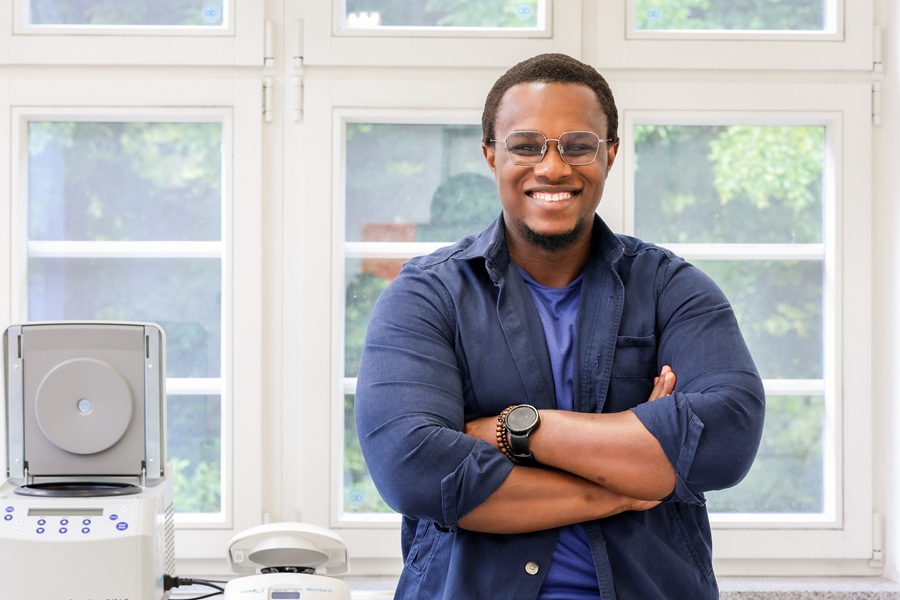
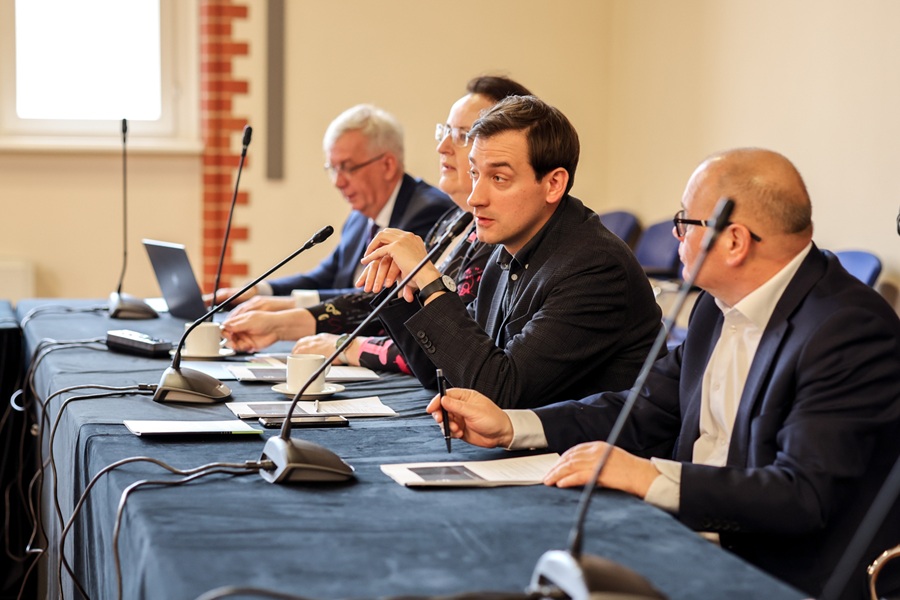
Dr. Maria Zdończyk and Dr. Piotr Kenis have defended their doctoral dissertations. Although they represent different disciplines, they share a common way of looking at the world: through the lens of matter and the tools that allow them to study it at scales invisible to the naked eye. And above all, a curiosity about what else can be created from it. They work together at the Materials Research Laboratory at Łukasiewicz – PORT, where they combine their interdisciplinary expertise.
A chemist fascinated by the process of creation
Maria Zdończyk completed her PhD at the Doctoral School of the University of Wrocław, carrying out an industrial doctorate in collaboration with Łukasiewicz – PORT. Her supervisors were Dr. hab. Joanna Cybińska and Dr. Bartłomiej Potaniec. Her research focused on designing new hybrid silica-based materials doped with stable organic dyes. The goal was highly practical: to create structures that react to changing conditions, such as pH, without degrading even at high temperatures. As a result, Maria developed stable and reversible optical sensors that may be applied in electronics, photonics, and in the future also in sensors monitoring food freshness, pharmaceutical quality, or environmental parameters.
She has been associated with Łukasiewicz – PORT since 2018. She began as a laboratory technician and later joined research projects. “I like this place because it lets you combine science with practice. Here, research does not end with a publication—it can become a real technology,” emphasizes Dr. Zdończyk.
She is currently completing a postdoc at the E-BEAM Centre at VSB Technical University in Ostrava, where she studies how electron beams can image materials and modify them at the nanoscale, enabling the creation of new functional structures and microdevices.
“For me, science is not just a profession—it is a way of seeing the world, where even mistakes can lead to discoveries,” says Dr. Zdończyk. “In science, you combine precision with imagination. Something drawn on paper becomes real—visible under a microscope.”
After work, Maria relaxes by creating digital art—drawing in Procreate and designing illustrations.
A geologist exploring Earth’s past with innovative techniques
Piotr studied geology at the University of Wrocław, specializing in petrology and applied mineralogy. He also completed his PhD there under the supervision of Prof. Zdzisław Jary and Dr. Sebastian Arabasz.
In his research, he adapted a mining-origin technique—QEMSCAN—for scientific applications. Thanks to this approach, he reconstructed environmental changes over the last 190,000 years—from glaciation to modern times. His research focused on loess, fine dust deposits that form fertile chernozem soils essential for agriculture. Loess covers around 20% of Earth’s land surface and poses challenges for construction (roads, railway lines) due to its complex micro- and nanoscale structure. Piotr used advanced SEM and TEM imaging, combining geology with modern visualization methods.
Although his research explores Earth’s distant past, he is also interested in materials of the future—the evolution of elements and the creation of lunar and Martian regolith simulants.
He has worked at Łukasiewicz – PORT for eight years. “A major advantage here is unrestricted access to equipment and the chance to learn from experts. I was lucky to meet people who created an inspiring work environment. They motivated me to develop scientifically,” says Dr. Kenis.
In his free time, he tinkers, watches Korean cinema, and hikes in the mountains, where he combines his professional interests with his hobby by collecting minerals and fossils.
Microscopy – an interdisciplinary tool
Although Dr. Maria Zdończyk and Dr. Piotr Kenis specialize in different fields, microscopy is an essential tool in their daily work. By imaging structures at micro- and nanoscale, they study complex materials and design new functional ones. Observing the world at the scale of atoms allows them to identify details that determine how materials behave in practical applications.