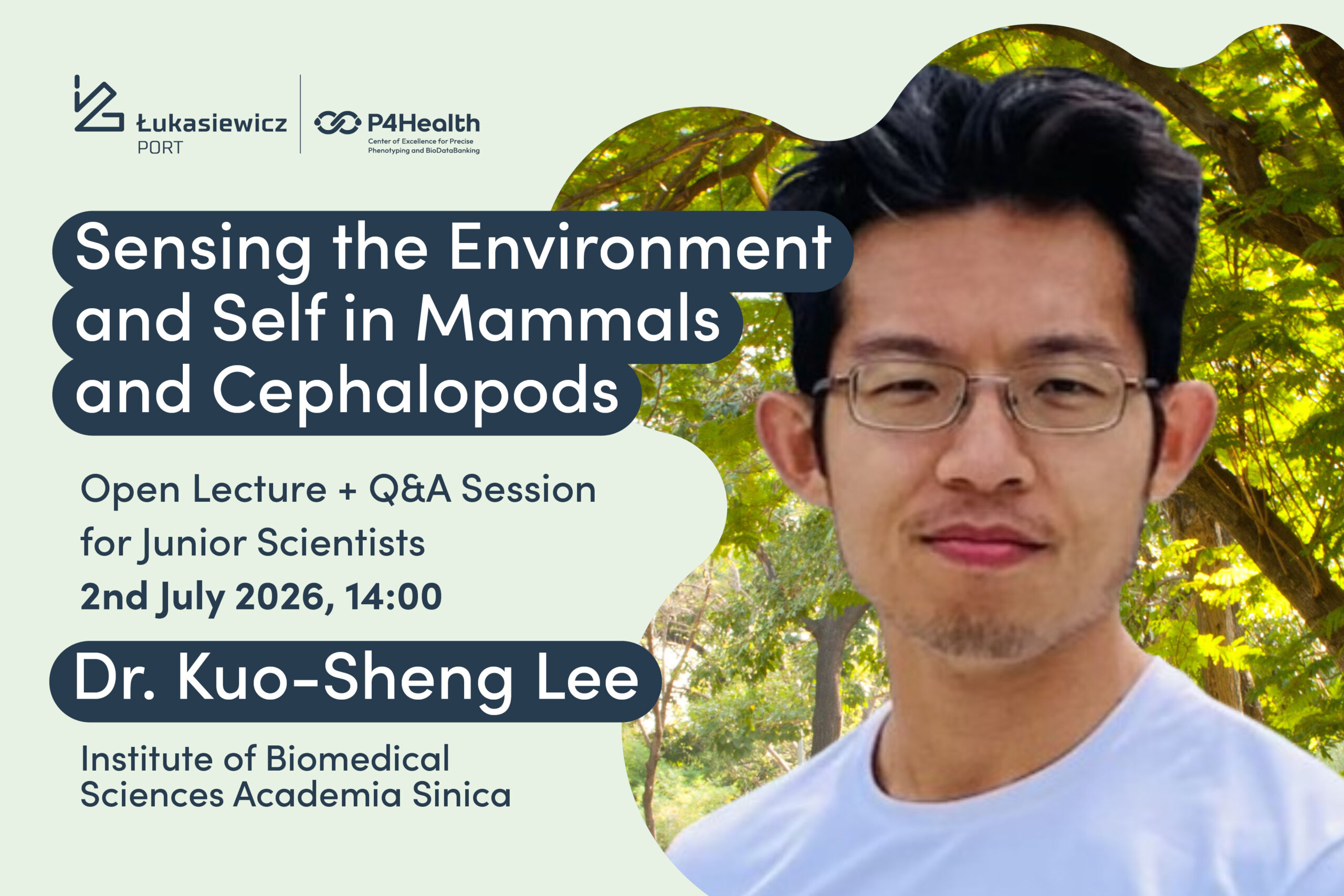
How does the nervous system integrate signals from within the body with signals from the external world? This question introduces the topic of the next open seminar, during which Dr. Kuo-Sheng Lee will discuss how animals continuously monitor both their surrounding environment and the internal state of their own bodies.
The lecture, titled “Sensing the Environment and Self in Mammals and Cephalopods,” will take place on July 2 at 2:00 p.m. in the auditorium at Łukasiewicz – PORT.
Dr. Kuo-Sheng Lee will present a comparative perspective on mechanisms underlying the perception of the body in mammals and cephalopods. He will discuss how organisms detect internally generated mechanical signals, and how this information is processed by the nervous system and used to control behavior.
The second part of the lecture will focus on research in octopuses – organisms with exceptionally complex nervous systems and a body plan fundamentally different from that of mammals. The speaker will address topics including proprioception, arm control, camouflage, wound healing, and the regeneration of complex neural circuits.
Comparing mammals and octopuses offers an evolutionary perspective on body perception. It shows that different organisms face a similar challenge – how to effectively sense signals from their own bodies and the environment – while developing distinct neural and behavioral solutions.
The seminar will be of particular interest to those working in neuroscience, comparative neurobiology, physiology, bioengineering, mechanobiology, motor control, and sensory integration.
About the speaker
Dr. Kuo-Sheng Lee is affiliated with the Institute of Biomedical Sciences, Academia Sinica in Taipei. His work examines sensory coding in mechanoreceptors and their associated central nervous system circuits, combining two-photon imaging, holographic optogenetics, electrophysiology, and closed-loop behavioral experiments.
He trained at the Max Planck Florida Institute and the University of Geneva. His publications include articles in Nature, Neuron, and Nature Neuroscience, and his achievements have been recognized with Academia Sinica’s Career Development Award and the Innovative Young Scholar Award.