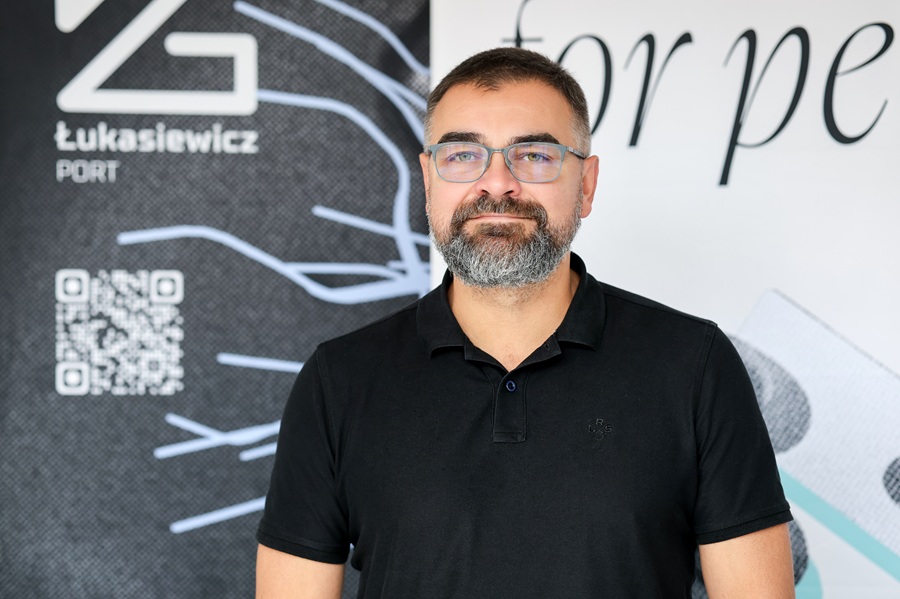
With funding from the Ministry of Science and Higher Education, Dr. Paweł Sega is building the BioValid platform, which will enable the analysis of microorganisms at the single-cell level.
Just a few years ago, the microbiome was discussed mainly within the scientific community. Today, it is one of the most rapidly developing areas of biological and medical research.
“The microbiome is a community of microorganisms that live together with us. That is why it is worth taking care of it,” emphasizes Dr. Paweł Sega, Head of the Genetic and Microbiological Diagnostics Laboratory at Łukasiewicz – PORT.
For a long time, the microbiome was associated primarily with the digestive system and digestion. Today, scientists are increasingly examining its role in immunity, metabolism, the body’s response to stress, the effectiveness of therapies, and the development of certain diseases. The microbiome can provide important information about the condition of the body. Specific groups of bacteria or features of microorganisms may be linked to particular biological processes, diseases, or responses to treatment. Such indicators – microbiological biomarkers – can support the development of more precise diagnostics, new therapies, and personalized medicine.
The goal of Dr. Sega’s project is to create a comprehensive platform for the analysis and validation of solutions based on microbiological biomarkers. The new infrastructure, acquired thanks to more than PLN 5 million in funding from the Ministry of Science and Higher Education under targeted grants for investments related to scientific activity, will enable advanced microbiome and biofilm research, studies on the effectiveness of microbiome-based therapies, and support for the development of diagnostic tests.
As part of the project, the laboratory will be equipped, among other tools, with a microbial cell sorter operating under BSL-2 biosafety conditions, a cytometer for assessing cell viability and pre-analyzing samples, a multi-mode plate reader for testing antibiotic efficacy, and a colony counter with artificial intelligence-based functions. The new infrastructure will allow scientists to analyze microorganisms not only at the level of entire populations or strains:
“BioValid will allow us to bring our analysis down to the single-cell level. This is important because even cells belonging to the same population may respond differently to active substances,” says Dr. Paweł Sega.
These capabilities are particularly important in the context of antimicrobial resistance, which the World Health Organization identifies as a growing threat to public health. The BioValid platform will support the identification of bacteria resistant to available therapies and the search for new mechanisms to combat them.
The Genetic and Microbiological Diagnostics Laboratory supports research teams at Łukasiewicz – PORT, including in the areas of biological purity control of materials, sample validation, and microbiological analyses. It also collaborates with companies representing various sectors, including medtech, pharmaceuticals, cosmetics, textiles, veterinary medicine, and construction.
The BioValid platform will expand the laboratory’s service offering and respond to growing market demand for precision microbiological research.