Nearly PLN 2 million in funding awarded by the Polish Ministry of Science and Higher Education will support further work on a photonic biosensor that may in the future enable fast and highly sensitive medical diagnostics directly at the point of patient care.
The SENSOPTIC project – “Integrated Optical Sensor for Early Disease Diagnostics Based on Photonic Structures” – builds on research initiated at Łukasiewicz – PORT under the institute’s internal PORT TECH CALL program in 2025. Researchers will continue developing a photonic biosensor: a miniature device that uses light to detect the presence of specific biological substances in a sample. This type of technology could help bring diagnostics closer to patients, accelerate testing, and reduce the need to transport samples to specialized laboratories.
“This project continues work in which we have been building our expertise step by step: from designing photonic structures and fabricating them, to carrying out initial detection tests. Funding from the Ministry of Science and Higher Education allows us to move from verifying the technological foundations to developing a prototype with an increasingly well-defined medical application,” says Dr. hab. Joanna Cybińska, Deputy Director for R&D at Łukasiewicz – PORT.
From Simple Substances to Biomarkers
In the first stage of the work, researchers focused on designing and fabricating photonic structures capable of detecting simple chemical analytes, such as water or isopropyl alcohol. The key goal was to determine whether changes in the optical properties of the surrounding environment could be used for precise, real-time detection of substances.
The results confirmed that photonic phenomena can provide a strong foundation for advanced sensing technologies. The next step was to move from detecting simple chemical compounds toward biological applications. A multidisciplinary team began developing methods for activating and functionalizing the surfaces of photonic layers – in other words, preparing the sensor surface so that it can selectively bind specific biological molecules.
“What matters most in this technology is the ability to combine a sensitive optical system with a surface that can be biologically ‘programmed’ for a specific diagnostic target. This means we are not thinking about a single sensor for a single application, but about a platform that could in the future be adapted to detect a wide range of biomarkers,” explains Dr. hab. Joanna Cybińska.
How Does a Photonic Biosensor Work?
The biosensor being developed at Łukasiewicz – PORT is based on advanced photonic structures, such as Mach-Zehnder interferometers and photonic crystals, integrated with thin-film SiOx waveguides. In practical terms, this creates a miniature system in which light carries information about what is happening on the sensor surface.
When the target biomarker binds to a properly prepared surface, the optical properties of the system change. The sensor can detect this change without the need for additional chemical labels. This is why the technology is described as label-free.
Under the newly funded project, the team will focus on developing a device capable of rapidly and selectively detecting selected biomarkers. In the first phase, the biosensor will be adapted to measure steroid hormones, such as estrogen and progesterone. At the same time, the technology is being designed from the outset as a platform solution that could later be adapted to detect a broader spectrum of bioanalytes, including proteins, peptides, exosomes, bacteria, and viruses.
Diagnostics Closer to the Patient
One of the main assumptions behind the project is that the biosensor could be used in a point-of-care testing model, directly where patient care is provided. Ultimately, test results could be available within several minutes.
In the future, such a solution could shorten diagnostic timelines, improve access to testing outside large urban centers, and reduce pressure on the healthcare system. This is particularly important in medical areas where rapid biomarker identification can support clinical decision-making and enable more personalized therapies.
One Platform, Many Possibilities
The technology developed at Łukasiewicz – PORT aligns with a global trend toward biosensor-based diagnostics. Optical and photonic solutions are advancing particularly rapidly because they offer high measurement sensitivity, enable real-time analysis, and eliminate the need for chemical labels.
A key advantage of the approach developed at the institute is its potential versatility. Unlike many single-use biosensors, whose applications are limited from the start to one type of measurement, this solution is designed to allow modification of the bioreceptor layer without fundamentally changing the optical system itself. This opens the way to creating entire families of diagnostic devices based on a single technology platform.
The expected outcome of the project is a demonstrator of a photonic biosensor transducer that will confirm the feasibility of the technology and enable further application-oriented work toward implementation.
Photonics, Biotechnology, and Materials Engineering
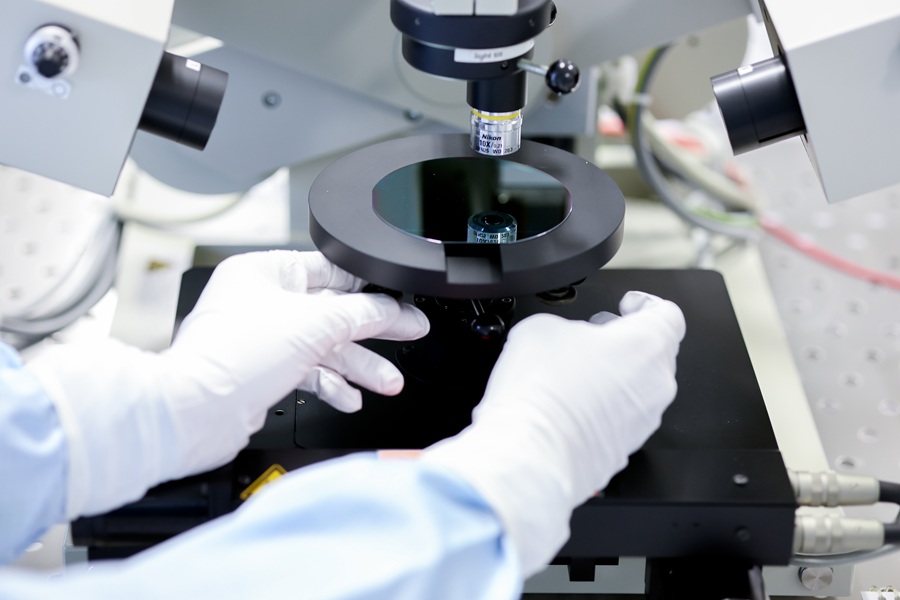
Łukasiewicz – PORT brings together diverse technological approaches: from the design and fabrication of photonic systems, through their biological functionalization, to the development of microfluidic sample analysis systems and the miniaturization of diagnostic platforms. The institute’s advanced laboratory infrastructure is also an important asset, enabling research and biological validation of the developed solutions under controlled conditions.
“The biosensor we are developing is part of a broader ecosystem of expertise that we are building at our institute. We combine photonics, bioengineering, and materials technologies to create solutions that can respond to the real needs of modern diagnostics,” adds Dr. hab. Joanna Cybińska.
The SENSOPTIC project is expected to provide new research methods in photonics and bioengineering and, in the longer term, lay the groundwork for the commercialization of compact biosensors. The material and technological platform developed within the project could eventually be applied across a broad spectrum of molecular diagnostics.
The project is financed from the state budget funds awarded by the Minister of Science and Higher Education under the “Science for Society Development” program.