The human brain contains 86 billion neurons and an equal number of glial cells responsible for support, nourishment and protection. Each neuron can form connections with thousands of others, creating a network of trillions of synapses. These connections determine the brain’s capabilities—making it extraordinary, yet incredibly difficult to study.
The human brain contains 86 billion neurons and an equal number of glial cells responsible for support, nourishment and protection. Each neuron can form connections with thousands of others, creating a network of trillions of synapses. These connections determine the brain’s capabilities—making it extraordinary, yet incredibly difficult to study.
Statistics underscore how urgent it is to understand the brain and the mechanisms underlying its disorders. Today, 179 million Europeans live with brain diseases, both neurological and psychiatric. This is equivalent to the combined populations of Germany, France and half of Poland. These conditions generate €800 billion in annual costs—45% of all European healthcare spending—and are now considered civilisation diseases, driven by modern lifestyles. The challenge is compounded by demographic trends: as societies age, the risk of neurodegenerative diseases such as Alzheimer’s and Parkinson’s continues to grow.
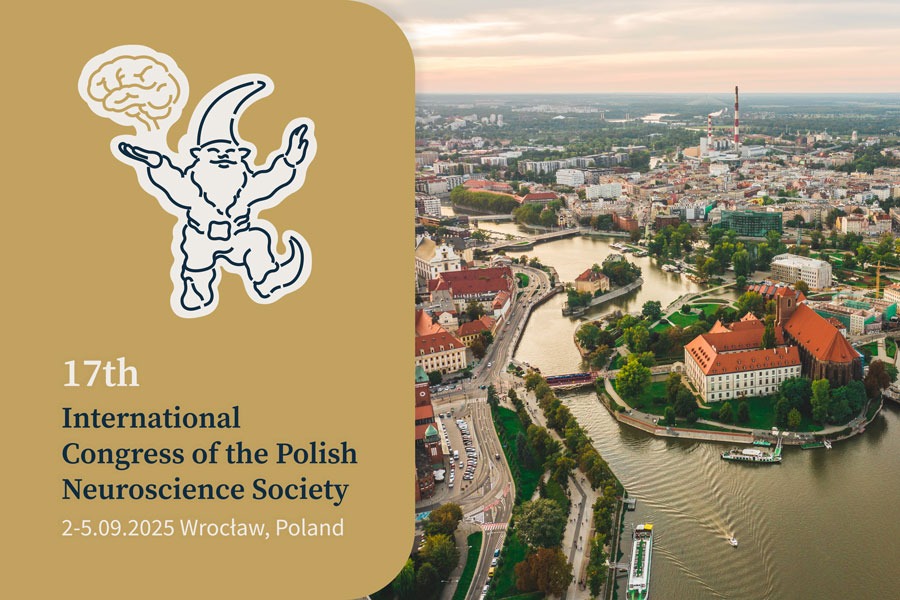
These issues will be at the heart of discussions among more than 300 researchers during the 17th International Congress of the Polish Society for Neuroscience (PTBUN), which opens on 2 September at the Wrocław University of Science and Technology Conference Centre. After thirty years since the first edition, the congress will finally take place in Wrocław—thanks to the strong involvement of the city’s neuroscience community.
From cancer pain to transgenerational memory
Neuroscience is not an abstract academic pursuit—it is a discipline of immediate need that already shapes the quality of life for one in four Europeans.
At Łukasiewicz – PORT, researchers investigating the brain focus on concrete health challenges directly affecting patients’ lives. They study the mechanisms driving cancer pain, depression, stress-related disorders and neurodegeneration. Their work integrates molecular biology, artificial intelligence, epigenetics and neuroimaging. The goal is not only to deepen our understanding of brain function, but to develop new therapeutic strategies.
Dr Mateusz Kucharczyk, Head of the Cancer Neurophysiology Research Group, investigates cancer pain—one of the most debilitating experiences for patients. At Łukasiewicz – PORT, his team explores mechanisms that could relieve pain without the risk of addiction or the side effects associated with opioids. “Pain is not merely a symptom. It is its own disease—one that destroys the psyche, relationships and daily life. Our goal is to develop therapies that are both effective and safe,” he explains.
Dr Bartosz Zglinicki of the Astrocyte Biology Research Group uses artificial intelligence to study the effects of antidepressant drugs. Advanced algorithms allow him to analyse how specific compounds influence the activity of defined brain regions—with a level of precision previously unattainable. AI helps visualise what the human eye cannot detect, bringing us closer to personalised medicine and tailored treatments.
Research led by Dr Ali Jawaid reveals how profoundly traumatic stress can affect not only individuals, but also their children. By analysing childhood neglect in Poland and Pakistan and studying families affected by the Srebrenica massacre, his team has demonstrated that the consequences of trauma can be transmitted biologically across generations. This insight reshapes our understanding of the rising prevalence of mental health disorders in Europe and supports preventive and therapeutic innovations.
“Psychological trauma does not end with the individual experience. It remains in the body, in cells, in the brain—and it can influence children who were never directly exposed to the trauma,” says Dr Jawaid, Head of the Translational Neuropsychiatry Research Group. “Trauma is not just a risk factor—it is an inheritance.”
Researchers from Łukasiewicz – PORT will present their findings during the PTBUN International Congress.
World leaders in neuroscience to gather in Wrocław
“The congress will host leading brain researchers from across the globe—recognised figures in world neuroscience,” says Dr Michał Ślęzak, scientist at Łukasiewicz – PORT, Vice President of the Society and Chair of the Organising Committee.
Speakers will include:
- Prof. John Cryan, University College Cork, Ireland – pioneer of gut–brain axis research (how can certain brain disorders be supported through microbiome-based interventions?)
- Prof. Lora Heisler, University of Aberdeen – expert on brain regulation of metabolism and eating behaviour (what do now-popular drugs like Ozempic mean for skeletal muscle physiology?)
- Prof. Andrew Holmes, National Institutes of Health, USA – specialist in the neurobiological mechanisms of stress responses (how do alcohol and stress reshape the brain, and why not equally in everyone?)
- Prof. Marcin Szwed, Jagiellonian University – researcher of environmental influences on brain health (can air pollution inhaled by children contribute to ADHD symptoms?)
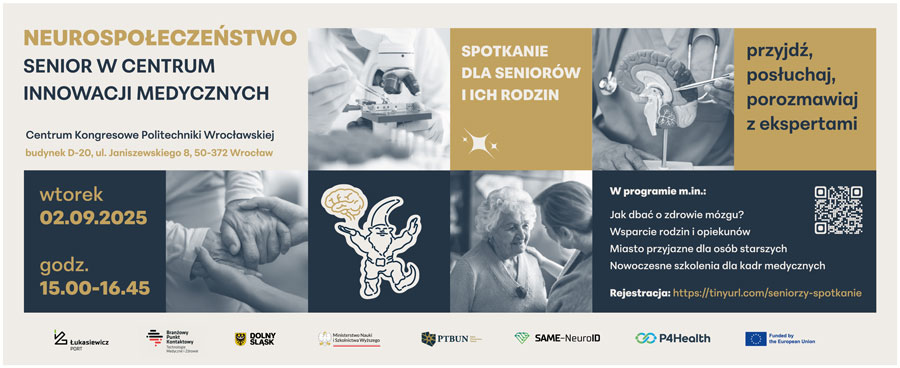
Neurosociety: Lower Silesia for seniors
A major accompanying event will be an open meeting for residents of Lower Silesia, older adults and their families:
“Neurosociety: Seniors at the Centre of Medical Innovation.”
This will not be an academic debate, but a practical conversation about everyday life—how to recognise early signs of dementia, where to seek help, how to support loved ones, and how to design brain-friendly cities.
The meeting will take place on 2 September, 15:00–16:45, at the Wrocław University of Science and Technology Congress Centre (Janiszewskiego 8). Participants will include scientists, clinicians, representatives of local authorities (co-organiser: the Marshal’s Office of the Lower Silesian Voivodeship) and senior organisations. Registration is required.