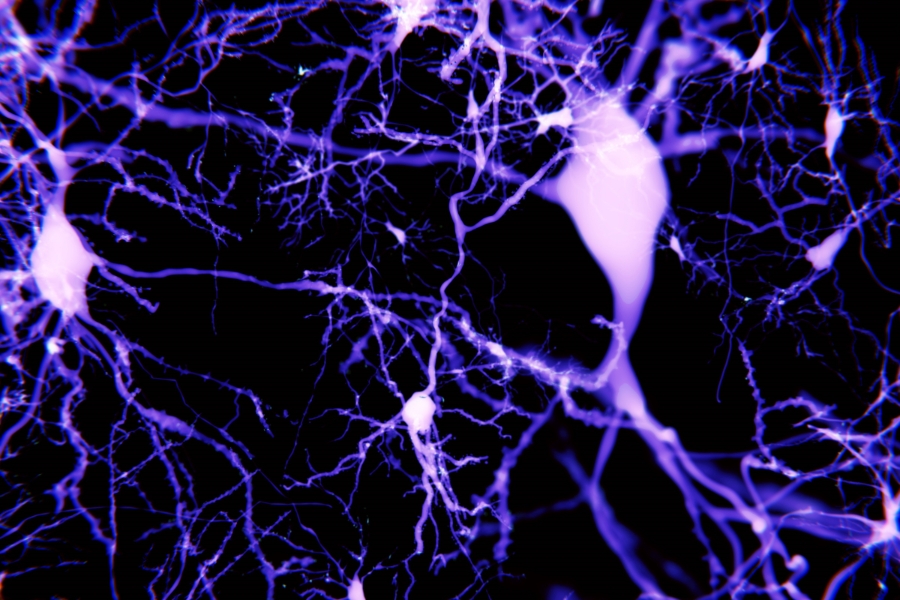
In Poland, according to data from the National Health Fund (NFZ), approximately 1.2 million people suffer from depression*. Worldwide, the number exceeds 280 million (WHO data**). Despite established treatment protocols, physicians and scientists continue to seek answers to the following questions.
What influence do genes have on the development of this disease, and how much depends on environmental factors?
Through which biochemical processes does the disease develop in the body?
Thanks to the research conducted by Dr. Michał Ślęzak and the Biology of Astrocytes Research Group he leads at Łukasiewicz – PORT, we are getting closer to finding answers.
For the past three years, the Biology of Astrocytes Research Group has been investigating the role of astrocytes – a type of brain cell – in the mechanisms of neural network disturbances associated with depression.
“The role of astrocytes and their impact on the development of depression have so far been underestimated. However, our research indicates a significant role of these cells in mediating the central effects of ‘stress hormones,’ that is, glucocorticoids, which regulate the metabolism of proteins, carbohydrates, and fats in our bodies. Our findings show that stress-induced disruptions in glucocorticoid signaling lead to impairment of many astrocyte functions, which in turn may result in abnormal neuronal activity in brain regions responsible, for example, for emotions and social behaviors,” explains Dr. Michał Ślęzak.
“Currently, in collaboration with the Max Planck Institute of Psychiatry in Munich and the Paris Brain Institute, as part of the SAME-NeuroID project, we are conducting studies aimed at translating our existing knowledge into new therapeutic strategies for depression. In particular, we are examining how specific genes regulate stress-induced changes in social behavior. At the molecular level, we generate human neural cells (such as astrocytes and neurons) to observe how certain variants of stress-response genes alter the biochemical parameters of these cells.”
Most scientists focus their research on various types of neurons and neurotransmitters. At Łukasiewicz – PORT, we examine cells whose impact on the development of depression has not been thoroughly explored, believing that this approach will expand general knowledge of the disease and lead to a significant breakthrough in its treatment.
Link to 2023 data
** 2022 report