Photonic Materials Research Group
The Photonic Materials and Structures Group (Photmat) focuses on developing advanced photonic materials with the ability to emit, detect, reflect, transmit, convert, manipulate, and control light.
Our research is centered on light–matter interactions, with particular emphasis on innovative materials such as perovskites and chalcogenides. These low-temperature, solution-grown materials are studied in a variety of photonic structures.
Our aim is to understand the behavior of these materials under different conditions by investigating their performance in structures of various dimensions, including quantum dots, nanowires, thin films, monolayers, and single crystals.
We also explore complex photonic architectures such as photonic crystals, plasmonic metasurfaces, and disorder-driven systems. This broad approach allows us to push the boundaries of current photonic technologies and open pathways for future innovations.
What We Work On
Our research bridges fundamental science with practical applications, focusing on photonic devices such as LEDs, lasers, and scintillators. We study various phenomena related to light–matter interactions, including both spontaneous and stimulated emission in perovskites and chalcogenides, whether doped or undoped.
The group also investigates how emitters interact with photonic crystals and plasmonic antennas, aiming to improve the performance of photonic devices by leveraging the nonlinear properties of these materials. A key aspect of our work involves the development and testing of scintillators and radiation detectors based on perovskites and chalcogenides.
In our labs, we produce quantum dots, thin films, and single crystals, as well as plasmonic structures via metal deposition. Nanostructures are further refined using photonic and electron-beam lithography, along with wet and dry etching techniques.
What We Do in the Laboratory
In our labs, we produce quantum dots, thin films, and single crystals, as well as plasmonic structures via metal deposition. Nanostructures are further refined using photonic and electron-beam lithography, along with wet and dry etching techniques.
To characterize these materials, we employ methods such as micro-photoluminescence, time-resolved photoluminescence, and single-photon emission measurements. We also evaluate scintillation properties at high energies and study optical fibers and waveguides for telecommunication applications.
Through this comprehensive approach, we contribute to the advancement of photonic devices that meet the growing demands of modern light sources and detectors.
Group members

Dr. Muhammad Danang Birowosuto
Muhammad Danang currently leads the Materials for Photonics research group within the Łukasiewicz Research Network – PORT Polish Center for Technology Development. He obtained his PhD from Delft University of Technology, where in collaboration with Saint-Gobain Crystals and Detectors he studied rare-earth-doped materials for the production of high-light-output scintillators. After completing his doctorate, he became a postdoctoral researcher at the University of Twente, specializing in photonics and nanotechnology.
His research includes mesoscopic light-intensity fluctuations, local density of states, and spontaneous emission in disordered photonic materials.
While working at Nippon Telephone and Telegraph, he made a significant discovery in the field of telecommunication systems enhanced by Purcell technology, earning the Director’s Award in 2014.
He holds four international patents related to Purcell scintillators, as well as lanthanide and halide perovskites.
He has secured multiple grants totaling over €2 million from Thales, Cintilight, Singapore, and Poland. He has published nearly 200 papers (h>index > 30) in top journals such as Nature Materials and Advanced Materials. He is a senior member of ACS and Optica, and serves as an editor for Frontiers in Materials and Micromachines.
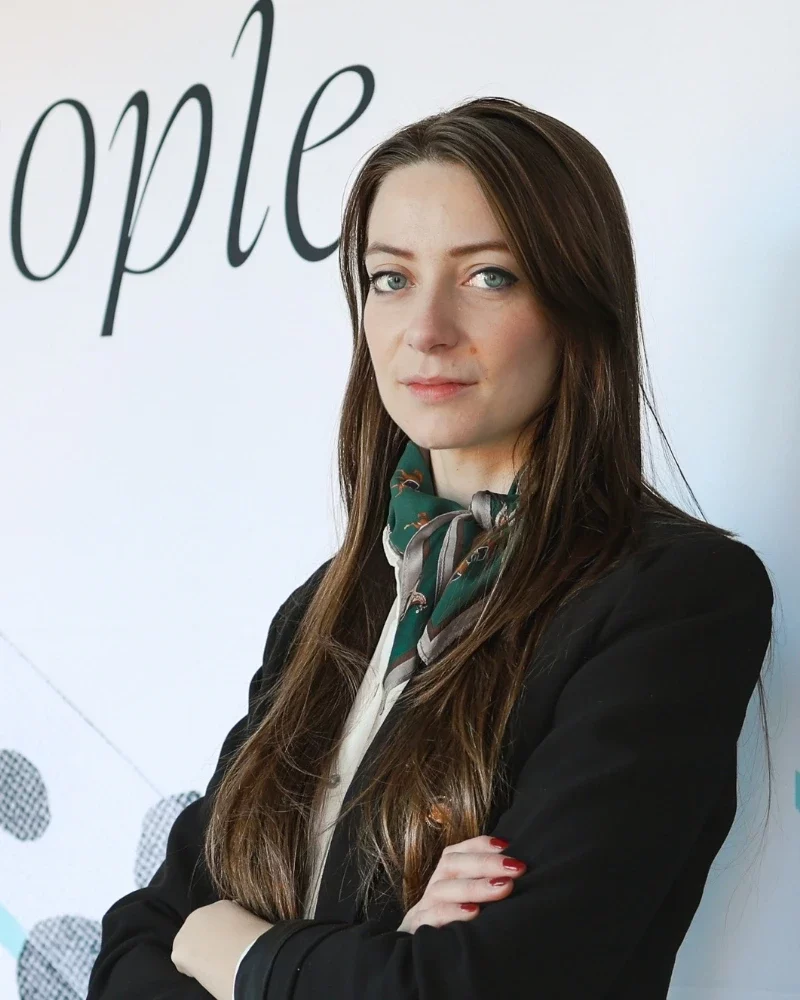
Dr. Anna Pniakowska
Anna is a Senior Research Engineer in the Materials and Photonic Structures group within the Łukasiewicz Research Network – PORT. She holds a double master’s degree in physical and chemical sciences, which she obtained while studying at renowned institutions: École Normale Supérieure Paris-Saclay (France), Universidad Complutense de Madrid (Spain), and the Wrocław University of Science and Technology as part of the MONABIPHOT program (Molecular nano- and Bio-Photonics).
She received her PhD in chemical sciences in September 2025 from the Wrocław University of Science and Technology, where she conducted research on the synthesis of gold nanoclusters with unique luminescent and chiral optical properties, and later analyzed their potential applications in optical microscopy and multifunctional devices.
She has participated in numerous research projects involving nanotechnology, photonics, and nonlinear optics. She has won numerous awards for her scientific achievements, including being recognized in the FNP ‘START’ competition as one of the top young researchers in Poland.
She is currently carrying out postdoctoral research within the NCN Opus (FAPURITE) project, where she works on the synthesis of plasmonic nanoparticles whose properties will be used to enhance optical effects in scintillating perovskite materials.
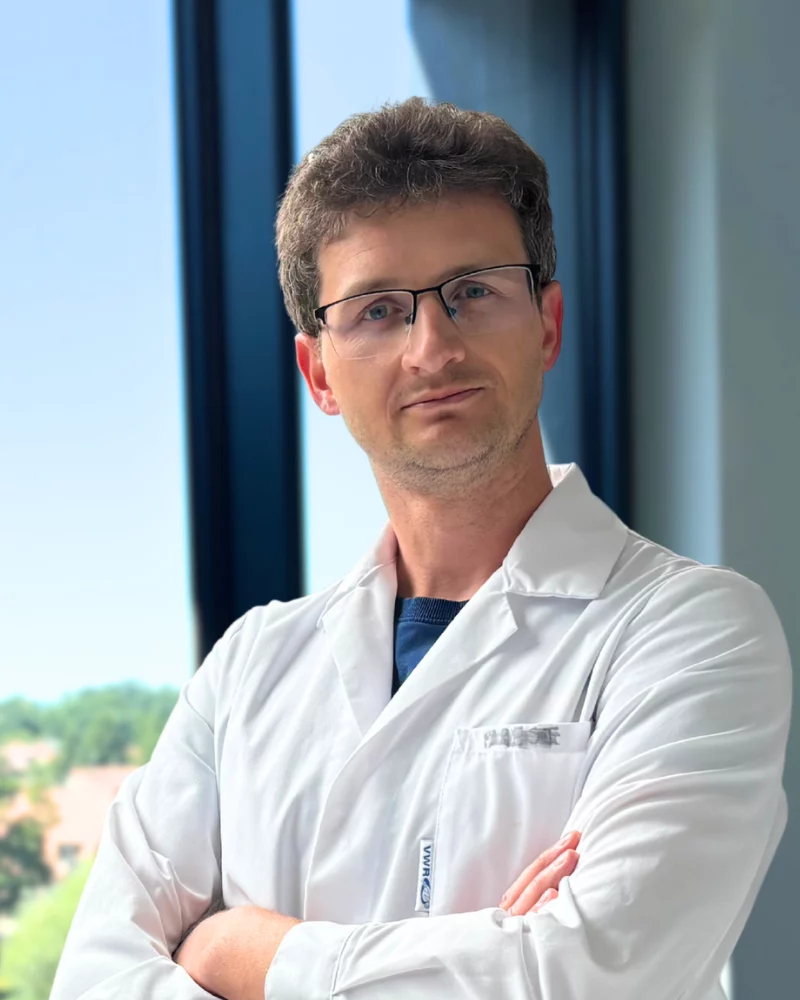
Dr. Dominik Kowal
Dominik is a Senior Research Engineer in the Photonics Materials research group at Łukasiewicz – PORT. To obtain his master’s degree, he completed the joint “MONABIPHOT” (Molecular Nano- and Bio-Photonics) program at ENS Cachan and Wrocław University of Science and Technology (WRUST). He later pursued doctoral studies at WRUST, where he conducted research on periodic structures in polymer optical fibers.
After two years as a research assistant at WUST, he joined Łukasiewicz – PORT in 2019. Since then, he has participated in multiple projects in materials engineering, nanotechnology, and photonics. His main research interests include design and fabrication of nanophotonic and fiber systems, as well as the development of new materials for photonic applications.

Dr. Somnath Mahato
Somnath is a Senior Research Engineer in the Photonics Materials research group at Łukasiewicz – PORT. He obtained his doctoral degree in October 2016 from the Indian School of Mines (ISM) in Dhanbad, India. During his PhD, he developed crystalline silicon (HIT Solar Cells) solar cell coatings using various transition metal oxides and conductive polymers as a window layer, transporting carriers at UPC Barcelona in Spain.
He then moved to SINP in Kolkata, India, as a research scientist, where he worked on structural characterization using grazing-incidence X-ray scattering (GISAXS/GIWAXS) and X-ray reflectivity (XRR) with synchrotron radiation sources at Photon Factory, KEK, Japan, and Elettra, Italy.
Later, he joined IIT Kharagpur in India, where he worked on stable-in-air, fully inorganic perovskite solar cell coatings, using certain atomic-scale research methods. He has now joined Łukasiewicz – PORT, where he aims to develop two- and three-dimensional perovskite monocrystals for optoelectronic applications.
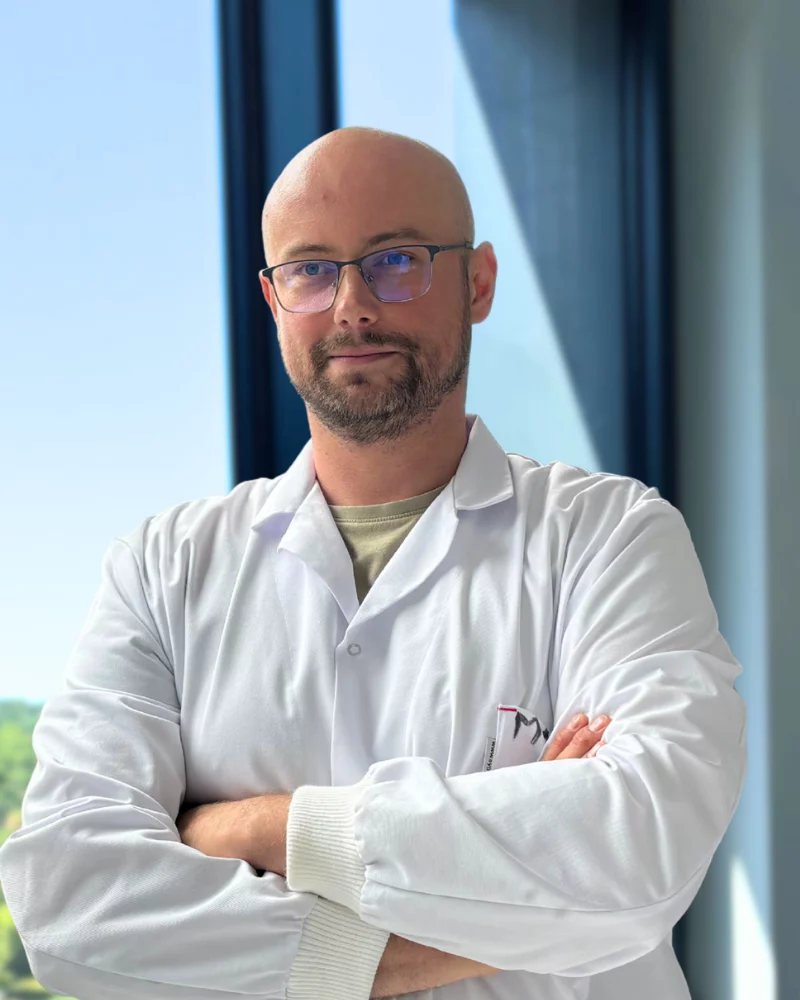
Dr. Michał Makowski
Michał , is a Senior Research Engineer in the Photonics Materials research group at Łukasiewicz – PORT. He earned his doctorate in 2021 at Nicolaus Copernicus University (UMK) in Toruń, where he studied the scintillation properties of gallium oxide (Ga₂O₃) single crystals as part of the NCN/DFG Beethoven project (GO-SCINT). During his doctoral studies, he completed internships at the Leibniz Institute for Crystal Growth (IKZ) in Berlin, investigating the electrical properties of Ga₂O₃ crystals, and at King Mongkut’s University of Technology Thonburi (KMUTT) in Bangkok, where he analyzed their scintillation properties using gamma radiation sources.
He gained research experience at the Leibniz Institute for Crystal Growth (Berlin) and KMUTT Bangkok, analyzing electrical and scintillation properties of Ga₂O₃ crystals. He also contributed to COST Action TD1401 (FAST). Currently, he works as a postdoctoral researcher in the NCN OPUS project (FAPURITE), focusing on synthesis and optical/scintillation properties of advanced Purcell-enhanced perovskites for bioimaging and security technologies.
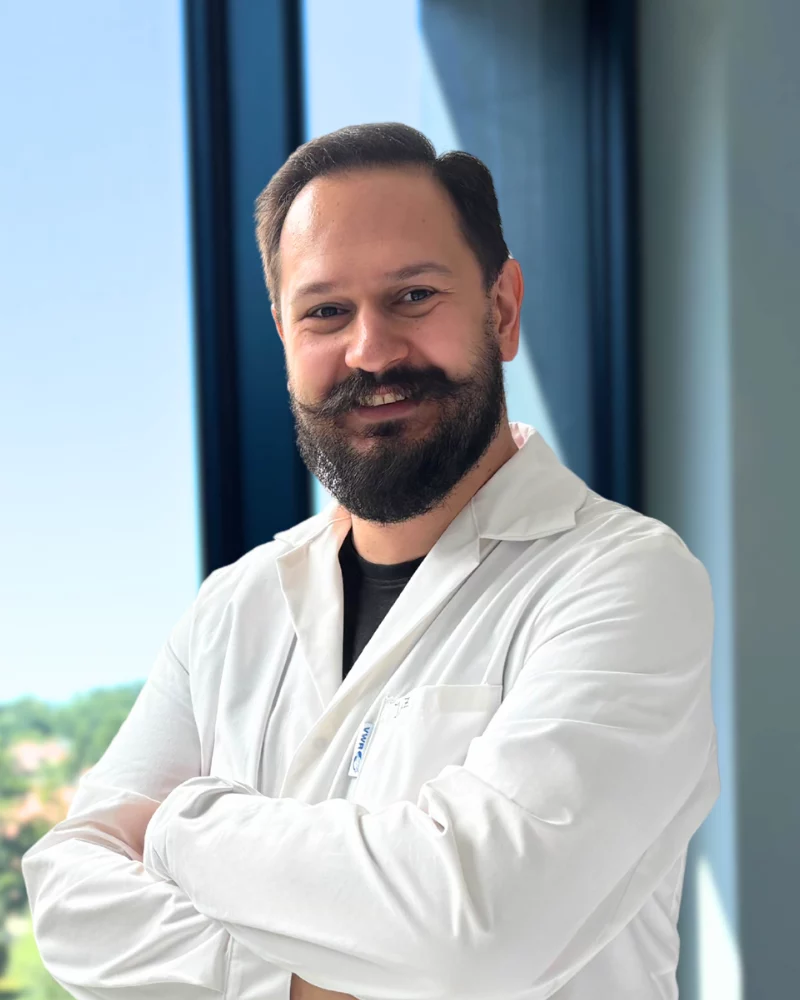
Dr. Jan Albert Zienkiewicz
Jan is a Senior R&D Engineer at Łukasiewicz – PORT, contributing to a collaborative R&D project with Cintilight Inc. (USA). He completed his B.Sc. and M.Sc. in Chemistry at Nicolaus Copernicus University, Toruń, with part of his studies at the University of Wrocław (MOST mobility program). He earned his Ph.D. in Chemical Sciences at the Institute of Low Temperature and Structural Research PAS, specializing in nanotechnology in biomedicine.
He gained research experience early in his career by completing research internships in Poland and Germany, and by working in several research positions, including as a contributor to projects funded by the National Science Centre (NCN). He was the principal investigator of his own NCN PRELUDIUM project on hybrid organic–inorganic lead halide compounds, which resulted in two peer-reviewed publications.
During his scientific career, he has given numerous conference presentations, earning multiple awards for scientific communication and research achievements. From 2023–2024, he took a career break to work in business development at XTPL S.A.