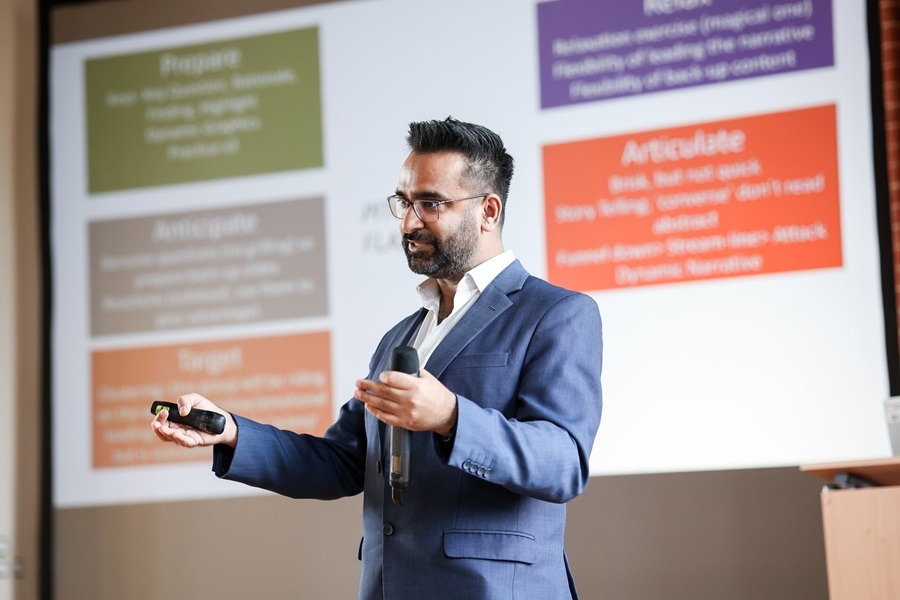
Łukasiewicz – PORT Polish Center for Technology Development cordially invites you to a lecture by Dr. Ali Jawaid, Head of the TREND Laboratory at the Center of Excellence for Neural Plasticity and Brain Disorders in Warsaw.
The lecture entitled “The Interplay between Metabolism and Epigenetics in Risk and Transmission of Neuropsychiatric Disorders” will take place on Friday, 31 March 2023, from 9:30–11:00 AM.
The event can be attended in person at Łukasiewicz – PORT (147 Stabłowicka Street, Wrocław) or online (live stream on the MS Teams platform.
For Young Investigators, a post-lecture Q&A session will be held from 11:00 AM to 12:00 PM. During this session, participants will have the opportunity to ask the guest speaker for advice on accelerating an academic career and avoiding common pitfalls and bottlenecks.
Dr. Ali Jawaid is a specialist in neurobiological sciences, spanning both clinical neurology and basic research. He graduated in medicine from Aga Khan University in Karachi, Pakistan, in 2007, and subsequently completed clinical and research training in neuropsychiatry at Baylor College of Medicine in Houston, Texas, USA. He then pursued doctoral studies in neuroscience in Switzerland, earning joint PhD degrees through the UZH/ETH International Program in Neuroscience and the UZH MD-PhD Program.
Dr. Jawaid has worked extensively in the field of epigenetics and neuropsychiatric disorders. He is the author of over 70 publications, including papers in Nature Neuroscience, Neuron, Nature Human Behaviour, Nature Communications, Trends in Genetics, EMBO Journal, and Molecular Neurodegeneration, as well as opinion pieces in Science and Nature. His current h-index is 26. Outside academia, he is a fiction writer, poet, and virtual reality enthusiast.
The keynote speaker heads the Translational Research in Neuropsychiatric Disorders (TREND) Laboratory at BRAINCITY: Center of Excellence for Neural Plasticity and Brain Disorders in Warsaw. The TREND Lab focuses on analyzing the relationship between non-coding RNAs and metabolic factors in the long-term consequences of early-life trauma, and investigates how metabolism can be manipulated to counteract neuropsychiatric symptoms across generations.
The meeting is part of the SAME-NeuroID project, funded by the Horizon Europe programme.