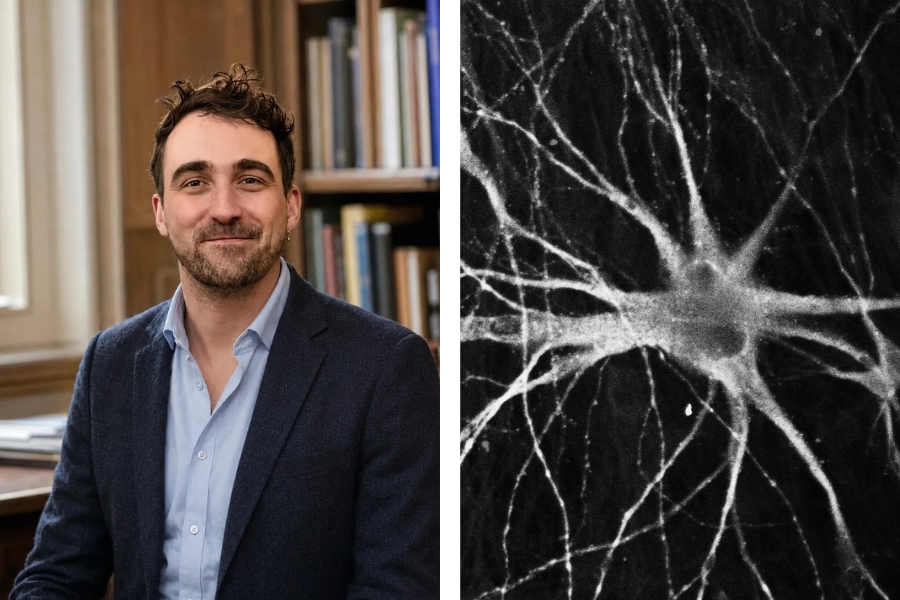
Pain is a complex experience that involves more than just nerve cells. Dr. Mateusz Kucharczyk and his team investigate the mechanisms underlying its development and regulation, with a particular focus on chronic pain. As part of the international DECIPHER project, the researchers are currently investigating the role of connective tissue cells in the development of neuropathic pain.
“Life without pain would be very tragic and short,” says Dr. Mateusz Kucharczyk. For a scientist who has spent years studying the mechanisms of pain, it is one of the most fascinating physiological phenomena. Pain warns us of danger, helps us avoid injury, and teaches us to recognize threats. The problem begins when pain loses its protective function. It may persist even after an injury has healed or continue as a result of a disorder affecting the nervous system. It can remain with a person for months or even years. Neuropathic pain is one of Dr. Kucharczyk’s main areas of research.
Neuropathic Pain – Causes and Treatment
“Imagine that a gentle brush against the skin, the touch of clothing, or a cool breeze causes severe pain. Stimuli that are normally harmless can be difficult to tolerate for someone with neuropathy,” explains Dr. Kucharczyk.
Neuropathic pain results from a lesion or disease affecting the somatosensory nervous system. It can develop following a nerve injury, surgery, or viral infection, as well as in the course of diabetes or cancer treatment. Some chemotherapy drugs damage not only cancer cells but also peripheral nerves. In some patients, this leads to painful neuropathy that can persist long after treatment has ended. Importantly, different types of neuropathy can produce different symptoms. Patients who have undergone chemotherapy may be particularly sensitive to cold, while certain forms of diabetic neuropathy are characterized primarily by altered sensitivity to mechanical stimuli. These differences provide valuable clues for neurophysiologists, helping them identify which populations of neurons may be responsible for a patient’s symptoms.
Despite major advances in medicine, pharmacological treatment options for neuropathic pain remain limited. Similar classes of drugs have formed the basis of treatment for decades, and their effectiveness varies considerably. The main medications used include gabapentinoids and certain antidepressants. Because the condition is chronic, patients often require care for many years. The demand for specialized pain management is high, and clinics treat patients whose pain arises from a wide range of underlying mechanisms.
Dr. Kucharczyk has worked with pain management specialists in Poland and abroad for many years, combining clinical observations with neurophysiological research. He also recognizes that developing more effective therapies requires a broader understanding of pain mechanisms, including the roles of other components of the nervous system and its surrounding environment.
DECIPHER Project – A New Perspective on the Mechanisms of Neuropathic Pain
Researchers have decided to investigate cells that were long regarded primarily as structural components: connective tissue cells expressing the CD90 marker (CD90+ cells). It is now known that these cells do more than simply provide structural support. They can release signaling molecules and communicate with the immune and nervous systems. Researchers suspect that they may also contribute to the development and persistence of neuropathic pain.
DECIPHER is a three-year project conducted by an international consortium of five scientific and clinical institutions. Its budget is €1.4 million. The Polish partner’s participation is funded by the National Centre for Research and Development (NCBR) under the fifth ERA-NET NEURON Cofund 2 call. The consortium is coordinated by Prof. Franziska Denk of King’s College London, with whom Dr. Kucharczyk has collaborated for more than a decade. Researchers from the University of Würzburg, the University of Zurich, and an academic institution in Istanbul are also participating. Łukasiewicz – PORT is the Polish partner.
The project aims to determine whether CD90+ cells influence neuronal excitability and, consequently, the generation of abnormal pain signals. Researchers also want to investigate whether targeting these cells could eventually provide the basis for new treatments. The studies will involve biological samples obtained from patients as well as preclinical experiments. One of the techniques used will be spatial gene expression analysis, which makes it possible to examine which genes are active in individual cells and where those cells are located relative to one another. This is important because their interactions may also depend on their spatial arrangement within the tissue.
Dr. Kucharczyk’s team, the Cancer Neurophysiology Research Group, is primarily responsible for the preclinical research. Using experimental models, the team will investigate mechanisms suggested by clinical observations and analyses of human tissue samples. If the studies confirm the role of CD90+ cells in pain regulation, new therapeutic targets may be identified.
How Does the Brain Suppress and Amplify Pain?
“Imagine someone walking around their home who steps barefoot on a piece of glass. The pain will be immediate and intense. But if the same person steps on glass while running away from an aggressive dog or while on a battlefield, they may not even notice the injury for some time.” Dr. Kucharczyk uses this example to illustrate that pain intensity does not depend solely on the extent of tissue damage.
The brain has its own mechanisms that can suppress or amplify the processing of pain-related information. It does so through descending neural pathways that reach the spinal cord, where signals arriving from peripheral parts of the body are processed and modified under the influence of activity in the central nervous system.
“Pain is in the head,” says Dr. Mateusz Kucharczyk, immediately emphasizing that the experience of pain depends on many factors, including emotions, stress, sleep, previous experiences, and the situation we find ourselves in.
However, the subjective experience of pain is not the same as the activity of nerve cells. Neurophysiologists primarily study nociception, the processes involved in detecting and processing potentially harmful stimuli. Neuronal activity can be measured with great precision. Researchers record the electrical firing of neurons and examine how they respond to pressure, temperature, and other types of stimulation.
For Dr. Kucharczyk, comparing findings from patient studies with laboratory experiments is particularly important. If a specific group of patients exhibits hypersensitivity to cold, researchers can focus on the neurons responsible for detecting such stimuli. Genetic tools then make it possible to selectively investigate the activity of specific neuronal types in preclinical models, rather than analyzing all cells simultaneously.
Neurophysiology and Clinical Practice
One of Dr. Kucharczyk’s greatest scientific inspirations is the collaboration between two pioneers of pain research, Patrick Wall and Ronald Melzack. In the 1960s, they developed the gate control theory of pain, which explains how activity in different nerve fibers can influence the transmission of pain signals in the spinal cord. One familiar everyday experience illustrates the principles behind this theory. When we bump our knee or elbow, we instinctively rub the painful area. Activating touch-sensitive nerve fibers, known as “A fibers,” can reduce the transmission of pain-related information. Transcutaneous electrical nerve stimulation (TENS), a neuromodulation technique used to treat certain pain conditions, relies on similar mechanisms.
Dr. Kucharczyk is particularly fascinated by the productive collaboration between these two scientists. Wall was a neurophysiologist who studied the nervous system using precise electrophysiological methods. Melzack brought a psychological perspective, focusing on the complexity of the human experience of pain. Together, they developed an approach that combined knowledge of neuronal function with observations of how pain is experienced.
Stephen McMahon, an internationally recognized pain researcher, studied directly under Wall and went on to develop an approach based on continuous exchange between basic research and clinical practice. He became Dr. Kucharczyk’s longtime mentor and friend. They met at an IASP congress in Japan in 2016. Known to his colleagues as “Mac,” McMahon held the prestigious Sherrington Chair of Physiology at King’s College London. Dr. Kucharczyk conducted part of his doctoral research in McMahon’s laboratory and subsequently worked there as a postdoctoral researcher and lecturer. He spent nearly a decade in London.
“Mac taught me how to conduct research and shaped me into an independent scientist. He passed away in 2021, on a Saturday. Just two days earlier, on Thursday, we had been working together late into the evening, performing spinal excitability tests. He passed on to me not only his knowledge and way of thinking, but also Wall’s scientific library, unique equipment, and research models. In doing so, he entrusted me with part of his scientific legacy, which I can continue to develop,” says Dr. Kucharczyk. “What was particularly important to us was the belief that clinical observations should lead to experiments, and that the results of those experiments should ultimately benefit patients.”
DECIPHER is an example of this approach: clinical partners contribute knowledge about patients and provide samples for analysis, while preclinical researchers investigate the biological mechanisms that may underlie the observed symptoms.
Cancer Pain – A Warning Signal That Comes Too Late
Dr. Mateusz Kucharczyk is also interested in types of pain that do not fulfill the typical warning function. These include pain associated with cancer.
Cancer can develop without causing pain for a long time, and symptoms sometimes appear only at an advanced stage of the disease. In such cases, pain does not warn of an approaching threat but signals a process that is already underway. Another example is central post-stroke pain, which develops following damage to brain structures responsible for processing sensory signals. Cases like these demonstrate how far the actual mechanisms of pain can extend beyond a simple sequence: injury, nerve signal, suffering.
For Dr. Kucharczyk, this is one of the most fascinating questions in modern neurophysiology and a reason to continue seeking answers about how individual cells and neural circuits function and interact.
Pain is an individual experience, but the mechanisms that give rise to it are more universal and can be studied in detail. A better understanding of these mechanisms is essential for developing more effective and precise treatments.