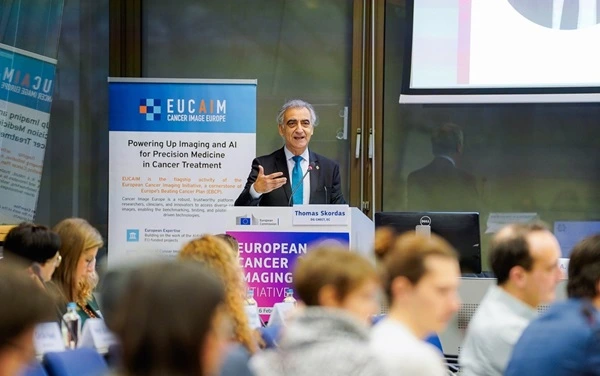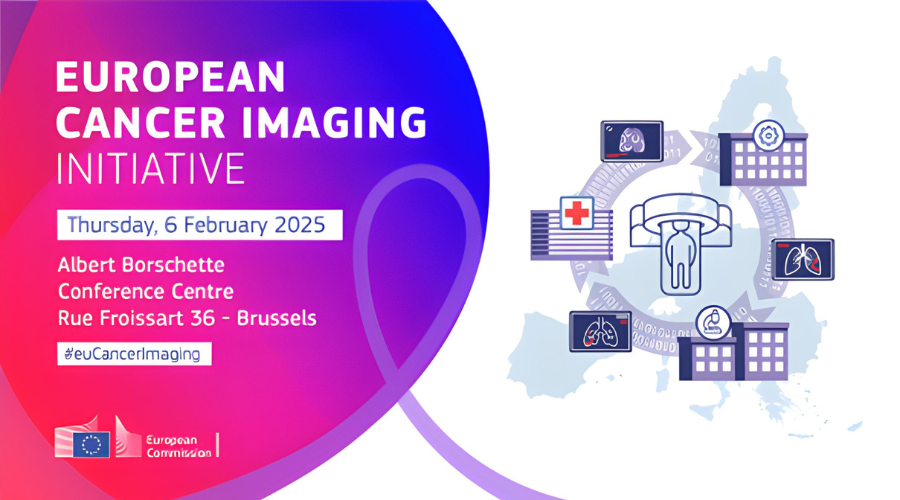
On 06/02/2025, the European Commission, together with the European Society of Radiology (ESR) and the European Federation for Cancer Images (EUCAIM), brought together 160 leading experts from policy-making, research, healthcare, and industry to explore how the European Cancer Imaging Initiative leverages health data and artificial intelligence to improve cancer detection and treatment.
Joining Forces to Save Lives
The European Cancer Imaging Initiative is a key pillar of the Europe’s Beating Cancer Plan and is being implemented by EUCAIM through the development of a pan-European federated infrastructure for cancer imaging—Cancer Image Europe. Two years after the project’s launch, an infrastructure has been established that provides secure access to an unprecedented volume of high-quality, standardized cancer imaging datasets. This unlocks the potential of AI-based solutions for earlier and more precise cancer detection, improved treatment planning, and better patient outcomes.
During the event, participants reviewed mid-term achievements, discussed next steps, sustainability, and stakeholder engagement, and placed these developments in the context of the European AI Act and the regulations on the European Health Data Space (EHDS).
Thomas Skordas, Deputy Director-General of DG CNECT, opened the event, emphasizing that access to data drives the development of artificial intelligence and that Cancer Image Europe has already made significant progress by making data available in a secure and privacy-preserving manner. Lorena Boix-Alonso, Deputy Director-General of DG SANTE, reminded participants:
“Every minute, five people in the EU learn that they have cancer. Early detection is crucial. […] Between 30% and 50% of cases can be prevented. Early detection can improve outcomes for many types of cancer. AI models trained on high-quality cancer images can become excellent tools for early detection. For example, in mammography, AI has increased detection rates by 29%, according to a recent Lancet study. The potential is even greater, and Europe must become a global leader in artificial intelligence.”
The Deputy Prime Minister and Minister of Health of the Czech Republic, Vlastimil Válek, highlighted the potential for advancing cancer management and care in Europe through AI-driven innovations in radiology. Juan Fernando Muñoz Montalvo, Secretary General for Digital Health, Information, and Innovation in Spain’s National Health System, praised EUCAIM as a pioneer in implementing the EHDS and a key driver of the AI Act, emphasizing Spain’s leading role in providing political and institutional support to ensure the long-term sustainability of the infrastructure. Spain also promoted a Member State support declaration recognizing the critical role of imaging in the development of precision medicine.
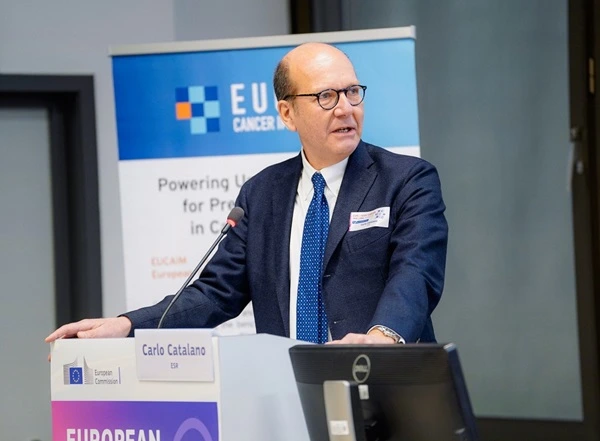
The ESR reaffirmed its full support for the European Cancer Imaging Initiative. Prof. Carlo Catalano, Chair of the ESR Board of Directors, stressed:
“Success requires interdisciplinary collaboration among radiologists, clinical societies, AI developers, patients, policymakers, and innovators, and initiatives such as EUCAIM play a leading role. A supportive policy environment and investments in infrastructure are key to unlocking the full potential of AI in European healthcare.”
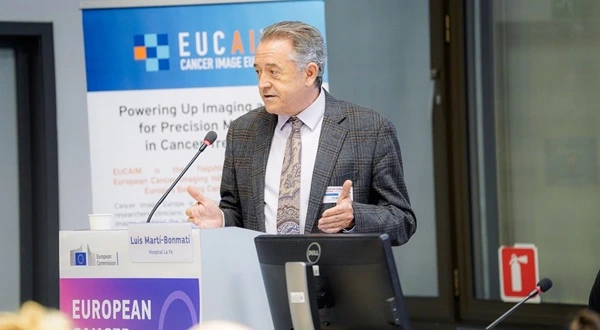
During the event, Prof. Luis Martí-Bonmatí, Scientific Coordinator of EUCAIM, highlighted key milestones and achievements, including the launch of the platform’s data search engine, the onboarding of new data providers, and the integration of AI tools for model validation and traceability.
“We have launched this pan-European, multi-country federated infrastructure that connects cancer images and tools at national and European levels to support AI solutions for precision medicine. Cancer Image Europe is an accelerator that will facilitate medical research and innovation within the European Health Data Space to better understand, diagnose, and fight cancer.”
Ensuring access to high-quality, structured, and interoperable cancer imaging data is essential for developing robust AI-driven innovations. Experts from EUCAIM emphasized that imaging data alone is not sufficient; metadata, clinical annotations, and interoperability frameworks are necessary for AI models to be effective in clinical practice. Prof. Katrine Riklund from Umeå University, who co-leads the clinical use cases in EUCAIM, noted:
“Healthcare is not about providing high-quality data to just anyone. We are here to care for our patients. Today, we need AI development to make cancer care better than yesterday. We must enhance collaboration—not only among different types of researchers within a hospital or country, but also across countries.”
EUCAIM’s leading technical experts stressed that data quality is paramount and that metadata and annotations are critical for clinical context. EUCAIM provides essential tools for data preparation, de-identification, and standardization, ensuring that AI models are built on reliable and well-structured data. The need for computing power and the role of AI factories in preparing for an AI-driven future were also emphasized.
A milestone in Europe’s approach to cancer imaging data is the EU Health Policy Platform Thematic Network led by ESR, titled “Advancing Precision Medicine for European Cancer Patients with AI-based Imaging”, and its resulting Joint Statement, endorsed by more than 80 stakeholder organizations. The statement underscores a shared commitment to advancing AI-powered precision medicine for cancer patients in Europe, ensuring that AI models are trustworthy, generalizable, and ready for clinical deployment.
Additionally, discussions addressed the proposed establishment of a European Digital Infrastructure Consortium (EDIC) to ensure the long-term stability and governance of the Cancer Image Europe platform, accelerating the development, benchmarking, certification, and deployment of AI-based cancer management tools for personalized medicine.
The EUCAIM Cancer Image Europe platform is already operational, with its data search engine live, federated processing capabilities expanding, and new data continuously being onboarded. Prof. Ignacio Blanquer, Technical Coordinator of EUCAIM, reported that EUCAIM has already developed a cancer imaging data search engine.
“Ensuring the traceability of AI models built on EUCAIM is crucial for their clinical credibility,” he said. EUCAIM remains committed to fostering innovation, supporting researchers, and ensuring that cutting-edge AI tools can be deployed in clinical workflows in the future.
Priit Salumaa from Better Medicine, an innovative AI medical imaging company, highlighted EUCAIM’s critical role in providing access to large volumes of high-quality data needed for innovation and in addressing two key challenges:
“Cancer is often diagnosed incidentally or simply too late. Half of radiologists’ work consists of repetitive tasks that can be automated. These are two key problems that must be solved.”
The European Cancer Imaging Initiative is actively shaping the future of AI in cancer care—empowering clinicians, accelerating research and innovation, and ultimately improving patient outcomes. As emphasized by Monika Hierath, Executive Director of EIBIR, the project coordinator, stakeholder integration and engagement are key to success:
“Engagement with stakeholders at all levels—including clinicians, AI researchers, innovators, policymakers, and patients—is necessary to ensure that the outcomes of the EUCAIM project translate into tangible health benefits for citizens through precision medicine.”
Contact Information
For more information about EUCAIM and the Cancer Image Europe platform, and to get involved, please visit www.cancerimage.eu or contact contact@cancerimage.eu.
Photos are available upon request at contact@cancerimage.eu.
European Commission event page, including access to the event recording:
https://digital-strategy.ec.europa.eu/en/library/european-commission-held-european-cancer-imaging-initiative-joining-forces-save-lives-event