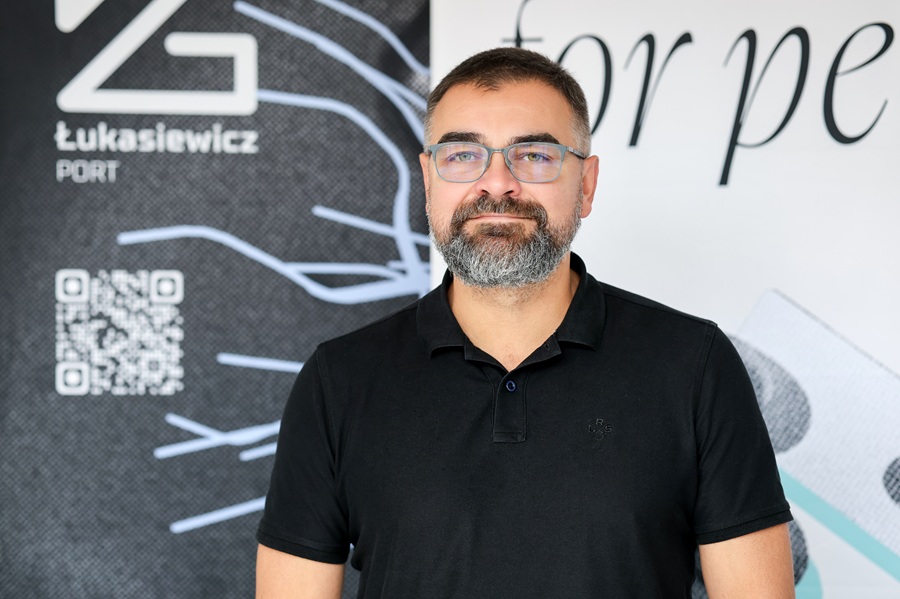
As the head of the Translational Neuropsychiatry Research Group at Łukasiewicz – PORT, Dr. Ali Jawaid studies the mechanisms of transgenerational trauma and explores how knowledge of fear, aggression, and empathy can help prevent conflicts, curb escalation, and support mediation efforts.
Why do we need neuroscience in conversations about peacebuilding?
When we think about war, we usually think about politics, borders, or weapons. In our article Can Neuroscience Inform Peacebuilding?, recently published in European Journal of Neuroscience, we ask a different question: what happens inside the human brain that allows fear to become hatred, hatred to become violence, and violence to be passed from one generation to the next?
This perspective grows out of our research on transgenerational trauma and our mission to use science for the betterment of humanity. As scientists, we describe in great detail how traumatic experiences affect the brain, the body, and subsequent generations. This knowledge can be expanded to understand the processes that lead to violence and, in turn, to try to stop them.
Neuroscience studies how we perceive threats, experience emotions, and form relationships. We most often use it to study diseases and disorders. We ask less often why people begin to hate one another, become vulnerable to manipulation, or can be persuaded to take actions they would once have considered unimaginable. Yet these processes also have neuropsychological underpinnings.
What can neuroscience tell us about the roots of conflict?
A distinction is critical here. Conflicts definitely cannot be reduced to biology. They have political, historical, social, and economic causes. Neuroscience can, however, help explain why people become more vulnerable to fear, prejudice, and manipulation under certain conditions.
The human brain is highly sensitive to threats. From an evolutionary perspective, detecting danger fast or even preemptively can help us survive. The problem begins when an ambiguous or symbolic threat is perceived as existential. Once the brain believes survival itself is at stake, fear can begin to override reason.
And so, three elements often arise in conflict. First, the danger is perceived as greater than it actually is. Second, prior experiences intensify distrust or hostility toward another group. Third, communities may be deliberately turned against one another through propaganda.
Fear limits our ability to assess a situation calmly. Highly emotional content, especially content tied to group identity, begins to take precedence over facts. This is why it is so important to ask ourselves where our beliefs come from.
What role does collective trauma play?
Societies that have experienced war, genocide, or forced displacement may remain more sensitive to threats for generations. This does not mean that trauma automatically leads to aggression. It can, however, make narratives invoking fear and historical suffering especially effective.
A community that is suffering may also lose the ability to recognize the suffering of the other side. This is why talks conducted solely at the diplomatic level are often not enough. We need dialogue that takes into account the experiences and trauma of both sides, essentially trauma-informed dialogues. Understanding this mechanism may help negotiators avoid reinforcing fear and a sense of threat.
Can empathy be cultivated?
That’s a beautiful question. People often think empathy is a personality trait that you either have or you don’t. Neuroscience suggests something more hopeful – that empathy is also a skill, and like many skills, it can be strengthened. To put it simply, empathy is the ability to relate to another person’s experience. It can be developed through contact, shared experiences, and taking the perspectives of others.
Sometimes meeting a member of a group toward which we have felt hostility is enough to challenge our previous assumptions. We discover that this person has similar relationships, emotions, concerns, and needs.
One tool that can support this process is virtual reality. It allows people to experience a situation from another person’s perspective for a period of time. In our article we cite a study in which perpetrators of domestic violence assumed the victim’s perspective in a virtual environment. After the intervention, they were better able to recognize fear and showed less perceptual biase associated with aggression.
This does not mean that we already have a universal empathy enhancing tool. The research is still at an experimental stage. It does show, however, that even deeply ingrained responses may retain some degree of plasticity. Of course, virtual reality, neuromodulation, and psychological interventions must be used voluntarily, transparently, and under ethical oversight.
Should neuroscientists be involved in peace processes?
Absolutely. Initiatives already exist that bring together neuroscience, psychology, and peacebuilding. Some years ago, I spoke at the United States Institute of Peace, which supported work focused on analyzing the neuropsychological roots of conflict and the mechanisms involved in resolving it. You can watch this talk on YouTube.
However, many such projects remain within academia. Articles are published and models are developed, but the knowledge does not always reach mediators, negotiators, and decision-makers.
I think we should also acknowledge that neuroscience will not or cannot replace diplomacy or politics. It can, however, help us understand how to speak with trauma-affected communities, how to reduce polarization, and how to avoid intensifying the fear that impedes agreement.
Where should conflict prevention begin?
From the outset. Children should be taught empathy, courteous communication, how to recognize emotions, impulse control, how to critically evaluate information, and to conciously reject biases.
Many prejudices are passed down in families from one generation to the next. Schools can create a space where young people encounter other perspectives and begin to ask: Why do I dislike this group? Do I know any of its members? Is my belief based on experience, or was it passed on to me?
If we teach people to question their own hatred and recognize the humanity of people from other groups, we can influence not only one generation, but those that follow.
What is your Translational Neuropsychiatry Research Group currently working on?
The most important project of my career is a study of the mechanisms of transgenerational trauma in families of survivors of the genocide in Bosnia.
To our knowledge, this is one of the first studies to investigate whether the biological consequences of genocide experienced during childhood may be associated with the mental health of the next generation. We are studying two generations. The parents experienced genocide as children and now have children of their own. Among other things, we are analyzing epigenetic changes in the fathers’ germ cells and asking whether they may be associated with the mental health of their children, including symptoms of anxiety, depression, and ADHD.
We observe that some mental health problems are more severe among children in genocide-surviving families than in comparison groups. The next step will be to determine whether relatively simple interventions, like lifestyle interventions, can mitigate some of these effects.
You talk about war, trauma, and violence, yet you remain optimistic. What does optimism mean to a neuroscientist?
Well, I have always been a hopeless case! But on a serious note, optimism is an important part of resilience. It should not be confused with wishful thinking or denial of reality. It does not mean believing that everything will work itself out. It just means maintaining a positive outlook and turning it into action. So how can we be optimistic about wars and traumas, let me put it this way:
If we understand why people succumb to fear and manipulation, we can try to counteract them. If we know that empathy can be developed, we can create conditions that strengthen it. And if we know that trauma can affect subsequent generations, we can look for ways to break the cycle. And yes, I do have hope from our youth. This may sound slightly humorous, but I believe Gen Z can save the world.